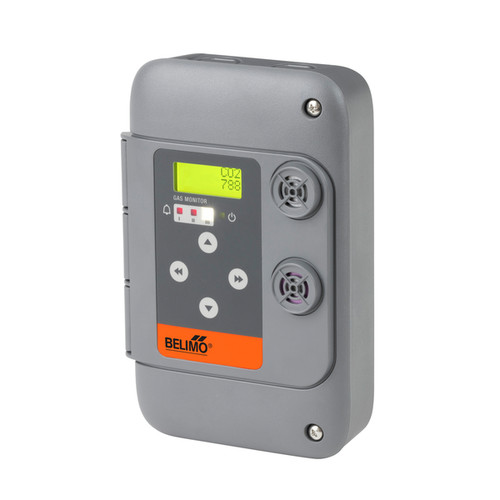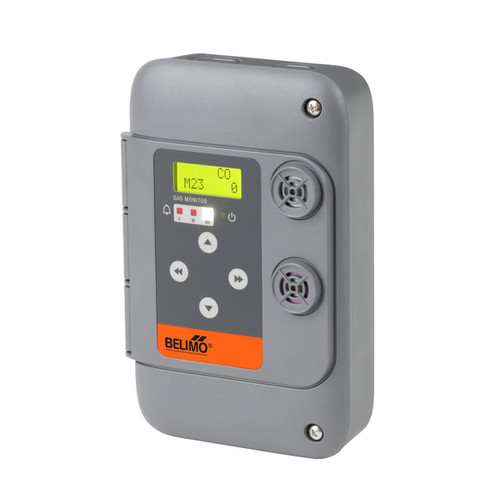


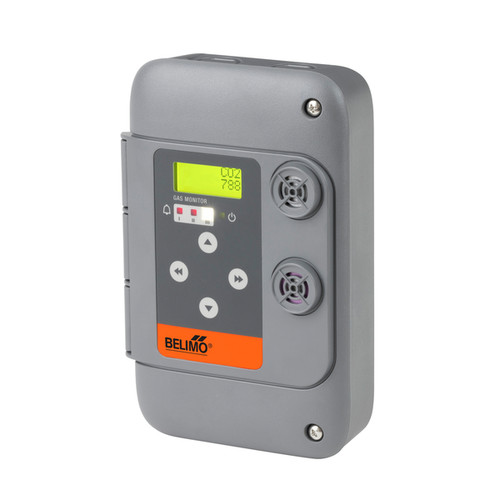
The 22G15-5A5 is a Belimo factory-calibrated gas monitor for Carbon Dioxide detection in HVAC and life-safety applications. The unit measures gas concentration over the 0-5,000 ppm range using a Non-Dispersive Infrared (NDIR) dual-channel (reference compensation) sensor element, with 3-level alarm response: Level 1 visual (red LED), Level 2 visual (red LED), and Level 3 audible + visual (80 dB horn @ 1 m + white strobe LED). An on-housing LCD displays the live gas concentration, gas type, and current alarm level. This variant is the 1 Relay + 2 Analog + BACnet configuration — full-feature variant with one SPDT relay output for direct fan/damper activation, plus two configurable analog outputs (0-5V, 0-10V, 1-5V, 2-10V, 4-20 mA — all switch-selectable) for BAS integration. Both CAN bus and BACnet MS/TP communication, allowing standalone networking with up to 32 monitors AND native BMS integration. The monitor is cULus listed to UL 2075 (gas detection systems) and ULC-S588 (Canadian vehicle emissions), with BTL (BACnet Testing Lab) listing for confirmed BACnet interoperability. CAN bus daisy-chain wiring networks up to 32 monitors to a single system. A 5-minute warm-up period brings the monitor online after power-up. Coverage area is approximately 50 ft radius / 7,500 ft² per unit (assuming unobstructed airflow).
Carbon Dioxide life-safety monitoring per applicable code: ASHRAE 62.1 (demand-controlled ventilation), Title 24, IECC. Typical applications: extended-range CO2 monitoring in spaces with elevated baseline — gymnasiums, auditoriums, dense classroom occupancy, food processing, breweries, fermentation rooms. Dual-channel NDIR is more accurate at higher concentrations than ABC logic. Same gas, other output configurations: 22G15-5B5 (2 Relays + BACnet). Other CO2 ranges: 0-2,000 ppm, 0-10,000 ppm.
The 22G15-5A5 responds to rising gas concentration in three stages: Level 1 (warning) — red LED illuminates, sending an early-stage notification to occupants and the BAS. Level 2 (elevated alarm) — red LED illuminates at a higher intensity / pattern to indicate progression. Level 3 (emergency alarm) — visual white strobe LED plus audible 80 dB horn @ 1 m (3.3 ft) demanding immediate evacuation or ventilation activation. All thresholds are field-configurable via the on-housing LCD interface or via BACnet/CAN bus.
cULus listed to UL 2075 (Gas and Vapor Detectors and Sensors) and ULC-S588 (Canadian vehicle emissions). cCSAus listed to C22.2 No. 61010-1-12 / UL Std. 61010-1 (3rd Edition), harmonized under IEC/EN 61010-1. BTL (BACnet Testing Lab) listed under BTL-30001 — confirmed BACnet protocol interoperability with third-party BMS systems. These certifications are required by most jurisdictions for code-compliant gas detection installations; verify with your local AHJ that the certifications meet your specific code requirement.
Sensor modules require annual recalibration per UL 2075 and Belimo specifications. The sensor module is field-replaceable (see datasheet for the specific R-G## replacement module part number) — when a sensor reaches end-of-life or fails calibration verification, the module is swapped out at the unit without replacing the entire monitor. Plan for calibration as part of annual life-safety system inspection alongside fire alarm and sprinkler system tests. Calibration verification is also recommended for installations above 2,000 ft elevation, as atmospheric pressure variation affects sensor readings.
Key Features
Combines one SPDT relay for direct fan/damper activation, two configurable analog outputs (0-5V, 0-10V, 1-5V, 2-10V, or 4-20 mA — switch-selectable) for BAS trending, and BACnet MS/TP for native BMS integration. Same unit handles code-required alarm triggering (relay), continuous BAS monitoring (analog), and detailed bus reporting (BACnet) without choosing between them.
Gas detection uses Non-Dispersive Infrared (NDIR) dual-channel (reference compensation) sensing — Belimo's standard sensing technology for CO2 at the 0-5,000 ppm range. Accuracy: ±50 ppm + 5% of reading. The sensor module is field-replaceable (R-G15-005) for annual calibration cycles.
Three escalating alarm levels — Level 1 visual, Level 2 elevated visual, Level 3 audible + visual emergency. The Level 3 alarm combines a flashing white strobe LED with an 80 dB horn measured at 1 m (3.3 ft) — sufficient to be heard in typical mechanical room and parking garage ambient noise. All thresholds are field-configurable.
Multiple 22G monitors network via CAN bus in a daisy-chain topology — up to 32 devices on a single bus segment. Each monitor maintains its individual gas detection while reporting to a centralized communication module or directly to the BMS via BACnet MS/TP (on A and B variants). Reduces wiring complexity in multi-zone parking garages and large mechanical rooms.
Communicates with the BAS via BACnet MS/TP — natively, with full BACnet device discovery. BTL listed (BTL-30001) confirms third-party BMS interoperability. All measured values, alarm states, calibration status, and configuration parameters exposed as BACnet objects. Configurable device instance, MS/TP MAC address, and baud rate.
LCD display on the unit shows the current gas concentration, gas type, and active alarm level. Used during commissioning to verify sensor response and calibration; used during service calls to read sensor state without connecting to the BAS. Visible in low-light conditions thanks to the backlight.
Single monitor coverage extends to a 50 ft (15 m) radius / 7,500 ft² (700 m²) area, assuming unobstructed airflow. For larger spaces, deploy multiple monitors on the CAN bus daisy chain. Walls, elevator shafts, full-height shelving, and other obstructions reduce effective coverage — the time-weighted average for the gas to reach the monitor increases.
Technical Specifications
| Specification | Detail |
|---|---|
| Sensor Style | Factory-calibrated gas monitor — life-safety / regulatory compliance |
| Measured Gas | Carbon Dioxide (CO2) |
| Measuring Range | 0-5,000 ppm |
| Sensing Technology | Non-Dispersive Infrared (NDIR) dual-channel (reference compensation) |
| Accuracy | ±50 ppm + 5% of reading |
| Replacement Sensor Module | R-G15-005 |
| Calibration | Non-interactive zero and span; annual recalibration required |
| Typical Response Time | <30 seconds (T90) |
| Warm-Up Time | 5 minutes |
| Long-Term Stability | <2% per year (NDIR) |
| Relay Output | 1× SPDT changeover, dry contact, 5 A @ 125 VAC non-inductive |
| Analog Outputs | 2× active analog — 0-5V, 0-10V, 1-5V, 2-10V (default), or 4-20 mA (default), switch-selectable; min/max selectable |
| Communication | CAN bus + BACnet MS/TP |
| Coverage Area | 50 ft (15 m) radius / 7,500 ft² (700 m²) per monitor — unobstructed airflow assumed |
| Maximum Network Devices | Up to 32 monitors on a single CAN bus daisy chain |
| Display | LCD with backlight — gas type, gas concentration, alarm level status |
| Alarm Levels | Level 1: visual (red LED) / Level 2: visual (red LED) / Level 3: visual (white strobe) + audible (80 dB horn @ 1 m) |
| Audible Alarm | 80 dB horn @ 1 m (3.3 ft) |
| Visual Alarm | Red LED (Levels 1, 2); White strobe LED (Level 3) |
| Power Supply | AC 24V only (per UL listing) |
| Power Consumption | 5 VA AC / 1.7 W DC |
| Fuse Type | Thermal PTC, auto-reset |
| Cable Entry | 5× 1/2" EMT — 2 top, 2 bottom, 1 rear |
| Cable Specification | Power: 18-20 AWG; Communication: 22-24 AWG twisted pair, shielded, low capacitance |
| Enclosure Rating | NEMA 2 |
| Housing Material | UL94 5VA polycarbonate |
| Max Altitude | 6,562 ft (2,000 m); calibration verification recommended above 2,000 ft (610 m) |
| Pollution Degree | 2 |
| Ambient Humidity | 15-90% RH continuous; 0-99% RH intermittent, non-condensing |
| Ambient Temperature | -4 to 122°F (-20 to 50°C) |
| Mounting | Wall mount — height per local code and gas density (CO/CO2 typically 4-6 ft above floor; refrigerants 1-2 ft above floor) |
| Certifications | cULus to UL 2075, ULC-S588; cCSAus to C22.2 No. 61010-1-12, UL Std. 61010-1 (3rd Ed.); IEC/EN 61010-1; BTL listed BTL-30001 |
| EU Conformity | CE Marking |
| Quality Standard | ISO 9001 |
| Manufacturer | Belimo |
| Manufacturer Part Number | 22G15-5A5 |
| Warranty | 5-year factory warranty |
What's In the Box
- 22G15-5A5 gas monitor in UL94 5VA polycarbonate housing with factory-calibrated sensor module
- Mounting hardware (screws, dowels)
Recommended accessories (sold separately): A-22G-A04.1 remote sensor head extension (for installations where the sensor needs to be positioned away from the housing), and replacement sensor module R-G15-005 for annual calibration cycles.
Documentation
Frequently Asked Questions
What does the 22G15-5A5 measure and what's it used for?
It's a factory-calibrated Carbon Dioxide monitor for life-safety gas detection in HVAC and building applications. Measuring range is 0-5,000 ppm; sensor technology is Non-Dispersive Infrared (NDIR) dual-channel (reference compensation). Typical applications: extended-range CO2 monitoring in spaces with elevated baseline — gymnasiums, auditoriums, dense classroom occupancy, food processing, breweries, fermentation rooms. Dual-channel NDIR is more accurate at higher concentrations than ABC logic. Required by code in many jurisdictions: ASHRAE 62.1 (demand-controlled ventilation), Title 24, IECC.
What's different about the A variant?
Belimo 22G monitors come in three feature tiers: A = 1 relay + 2 configurable analog outputs + CAN bus + BACnet MS/TP (most flexible); B = 2 relays + CAN bus + BACnet MS/TP (dual-relay sequencing); C = CAN bus only (lowest cost, pairs with C-22G accessory modules for relay/analog/BACnet aggregation). This SKU is the A variant: full-feature variant with one SPDT relay output for direct fan/damper activation, plus two configurable analog outputs (0-5V, 0-10V, 1-5V, 2-10V, 4-20 mA — all switch-selectable) for BAS integration. Both CAN bus and BACnet MS/TP communication, allowing standalone networking with up to 32 monitors AND native BMS integration.
How does the three-level alarm work?
Three escalating thresholds, all field-configurable via the on-housing LCD interface or via BACnet/CAN bus: Level 1 (warning) — red LED illuminates as an early-stage notification; Level 2 (elevated) — red LED at higher intensity / pattern indicates progression; Level 3 (emergency) — white strobe LED plus 80 dB audible horn @ 1 m (3.3 ft) demanding immediate evacuation or maximum ventilation. The horn is sufficient to be heard over typical mechanical room and parking garage ambient noise. Wire the relay outputs (on A/B variants) to fans, dampers, or BAS alarm inputs to trigger the corresponding response.
Where should I install this monitor?
Wall-mount, height per gas density and local code: CO and CO2 are roughly the same density as air, so install at 4-6 ft above the floor (occupant breathing zone). NO2 is heavier than air, so install at 1-3 ft above the floor. Refrigerants are much heavier than air, so install 1-2 ft above the floor. Coverage is approximately 50 ft (15 m) radius / 7,500 ft² (700 m²) per unit assuming unobstructed airflow — walls, full-height shelving, elevator shafts, and large equipment chests reduce effective coverage. For larger or partitioned spaces, deploy multiple monitors on the CAN bus daisy chain. Always verify mounting location with the local AHJ (Authority Having Jurisdiction) and applicable code.
How is the sensor calibrated?
Belimo gas monitors ship factory calibrated — no calibration required at installation. However, sensor modules require annual recalibration per UL 2075 and Belimo specifications. Recalibration is performed on-site using a Belimo calibration kit (zero and span verification with traceable calibration gas). When a sensor reaches end-of-life or fails calibration verification, the sensor module (R-G15-005 for this gas type) is field-replaceable — the module swaps out at the unit without replacing the entire monitor. Plan calibration as part of annual life-safety system inspection alongside fire alarm and sprinkler tests.
How is this CO2 range different from the other 22G15 variants?
Three ranges in the 22G15 family: 0-2,000 ppm (suffix 3, NDIR ABC) for IAQ and demand-controlled ventilation; 0-5,000 ppm (suffix 5, dual-channel NDIR) for elevated-baseline spaces; 0-10,000 ppm (suffix 6, dual-channel NDIR) for life-safety leak detection. Each range uses a different replacement sensor module (R-G15-003 / -005 / -006).
How does the CAN bus daisy chain work?
Up to 32 22G monitors share a single CAN bus segment. Run a single 22-24 AWG twisted-pair shielded cable from monitor to monitor in a daisy-chain topology — no star topology, no T-branches. Each monitor's individual sensor data is transmitted on the CAN bus and can be read by other monitors or by a communication module / relay unit. The daisy-chain architecture dramatically reduces wiring in large installations vs running individual analog or BACnet drops for each monitor. Termination resistors at the bus endpoints are required.
Does it need 24V power?
Yes — 24 VAC or 24 VDC supported (AC 21.6-26.4V / DC 13.5-26.4V). Power consumption is 5 VA AC / 1.7 W DC. Note: per CSA/UL 61010-1 listing, all gas monitors and communication modules are rated to AC 24V only — for vehicle-emissions monitors (CO, NO2, CO+NO2), AC/DC 24V is acceptable under ULC-S588 and UL 2075. Verify with your AHJ which power supply rating applies to your installation. Compatible with standard 24V control transformers; reserve dedicated transformer capacity for the gas monitor system rather than sharing with actuators (the 80 dB horn draws significant power during alarm events).
- Sensor Type:
- Gas Monitor / Life-Safety
- Measured Gas:
- CO2
- Gas Detection Range:
- 0-5,000 ppm
- Sensing Technology:
- Non-Dispersive Infrared
- Replacement Sensor Module:
- R-G15-005
- Variant Tier:
- A
- Output Configuration:
- 1 Relay + 2 Analog + BACnet
- Communication:
- CAN bus + BACnet MS/TP
- Number of Relays:
- 1
- Number of Analog Outputs:
- 2
- Alarm Configuration:
- 3-level (Visual L1/L2 + Visual+Audible L3)
- Audible Alarm:
- 80 dB horn @ 1 m
- Display:
- LCD with backlight
- Coverage Area:
- 50 ft radius / 7500 ft²
- Max Network Devices:
- 32 (CAN bus daisy chain)
- Warm-Up Time:
- 5 minutes
- Power:
- 24 VAC/VDC
- Power Consumption:
- 5 VA AC / 1.7 W DC
- Conduit:
- 5× 1/2 EMT (2 top, 2 bottom, 1 rear)"
- Enclosure:
- NEMA 2
- Housing Material:
- UL94 5VA polycarbonate
- Certifications:
- cULus UL 2075 / ULC-S588 / cCSAus C22.2 No. 61010-1-12 / BTL Listed
- Calibration Interval:
- Annual