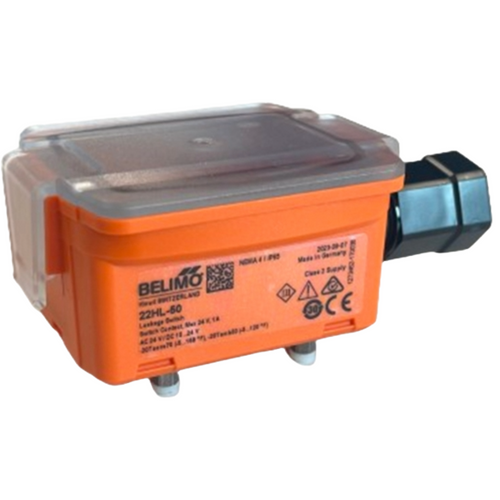


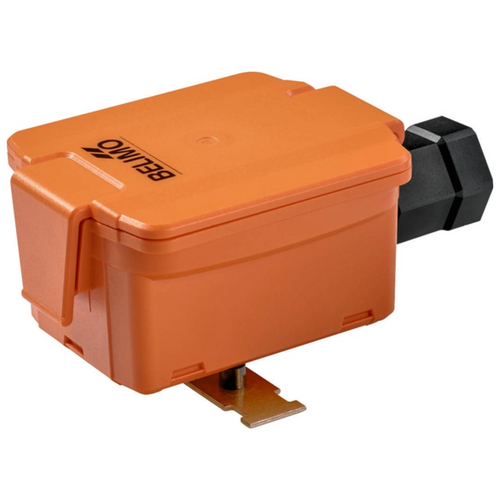
The 22HH-50 is a Belimo condensation switch designed to prevent dripping on chilled HVAC surfaces — chilled beams, chilled water piping, AHU cooling coils, evaporator surfaces, and any other cold surface where condensation could form when humidity is high enough to reach the dew point. The switch trips the instant condensation begins, BEFORE droplets form and damage ceilings or equipment below. The unit features an integrated sensor on the housing itself — mount the unit directly on the chilled surface being monitored (chilled beam underside, chilled water pipe, AHU cooling coil), with an SPDT dry contact relay output (max 1 A @ 24 V) that wires directly to a Belimo motorized cooling valve to interrupt cold water flow immediately, or to a BAS alarm input to trigger a controller response (raising the chilled water supply temperature, throttling the cooling valve, or alerting building operations). Mount the housing directly on the chilled surface itself: the sensor element is built into the housing, so the entire unit goes on the surface where condensation could form. An on-housing LED indicator (green = power OK, red = condensation detected) gives at-a-glance status without opening the housing. The polycarbonate enclosure (transparent top cover for LED visibility, orange UL94 5VA bottom) is rated NEMA 4X / IP65 with UL 2043 plenum compliance for installation in ceiling plenums per NEC 300.22(C) and IMC Section 602 — important for chilled-beam applications where the switch typically mounts in the return-air plenum above the suspended ceiling.
Chilled beam condensation prevention where the switch can be mounted directly on the chilled-water supply pipe, on the underside of the chilled beam, or on the AHU cooling coil header — anywhere the cold surface itself is accessible for direct sensor contact. The integrated sensor design (no external cable to route) is the simplest installation for these applications. Common deployment: wire the relay output in series with the chilled-beam cooling valve coil, so the valve closes automatically when condensation is detected, preventing further cooling water flow until the room's dew point drops. For the alternate sensor configuration (external sensor with 6.5 ft (2 m) cable), see 22HH-500X. For detection of pooled liquid (false floor leaks, AHU drain pan overflows) rather than surface condensation, see the 22HL family of leakage switches.
The on-housing LED gives clear visual status without needing to check the BAS: green when powered and sensing normally, red when condensation is detected at the sensing element. The transparent polycarbonate top cover lets the LED be read at a glance from the floor below during walkthroughs — useful for spotting installations where the cooling valve has been forced closed by repeated condensation events, indicating a chilled-water-supply-temperature setpoint that's too cold for the current room dew point.
Key Features
The sensor element is built directly into the housing — mount the entire unit on the chilled surface being monitored (chilled beam underside, chilled water pipe, AHU coil header). Simplest possible installation: one device, one mounting point, no separate sensor probe to route. Lower price point than the external-sensor variant.
The SPDT dry contact relay can be wired directly in series with a Belimo motorized cooling valve coil — when condensation is detected, the valve closes automatically to stop cold water flow, halting further cooling and preventing the chilled surface from continuing to drop below the room dew point. No BAS logic required for the shut-off; the BAS can be wired in parallel to receive notification.
Detects condensation at the very onset of dew-point formation on the chilled surface — well before water droplets accumulate, fall, or damage materials below. This is fundamentally different from a leak detection switch (which detects pooled water that has already fallen). Critical for chilled-beam systems and exposed chilled-water piping in occupied spaces.
Green LED indicates normal power-on operation; red LED indicates active condensation detection. Visible through the transparent PC top cover from below — facility staff and service technicians can verify sensor status at a glance during walkthroughs.
The relay returns to normal state automatically once the sensing element dries (room dew point falls below the chilled surface temperature, or the surface warms back up). No manual reset button, no field re-arming after a transient event — particularly valuable for chilled-beam installations above suspended ceilings where service access requires removing ceiling tiles.
Transparent polycarbonate top (LED visibility) and orange UL94 5VA polycarbonate bottom, sealed with NBR70 gasket — rated NEMA 4X / IP65 for wet/washdown environments. UL 2043 plenum compliant per NEC 300.22(C) and IMC Section 602, allowing installation in air-handling ceiling plenums above suspended ceilings — the typical mounting location for chilled-beam condensation switches.
Single SPDT (Single Pole Double Throw) relay with three terminals — Common (C), Normally Open (NO), Normally Closed (NC). Max 1 A switching current at 24 V, min 5 mA at 10 V. Use NC wiring for fail-safe behavior where loss of sensor power also triggers the cooling-valve close action. Dry contact (no internal voltage source) — installer supplies the load-side voltage.
Compatible with standard 24V control transformers shared with actuators and other sensors. AC 21.6-26.4V or DC 13.5-26.4V supported. Power consumption: 1.6 VA AC / 0.8 W DC — very low draw.
Conduit adapter ships in the box for direct connection to standard 1/2" NPT electrical conduit. Cable gland with strain relief supports ø6-8 mm cable diameter for installations without conduit. Pluggable spring-loaded terminal block (max 2.5 mm²) for power and load-side wiring.
Industry-leading factory warranty backed by Belimo's worldwide service network.
Technical Specifications
| Specification | Detail |
|---|---|
| Sensor Style | Condensation switch for chilled HVAC surfaces |
| Measured Value | Condensation (dew-point formation on cold surface) |
| Application | Water — chilled beams, chilled water piping, AHU cooling coils, evaporator surfaces |
| Sensor Location | Integrated sensor (on housing itself) |
| Output Type | SPDT dry contact |
| Max Switching Current | 1 A @ 24 V |
| Min Switching Current | 5 mA @ 10 V |
| Reset | Automatic after sensor dries |
| Display | LED — Green (power OK), Red (condensation detected) |
| Power Supply | 24 VAC/VDC (AC 21.6-26.4V / DC 13.5-26.4V) |
| Power Consumption | 1.6 VA AC / 0.8 W DC |
| Electrical Connection | Pluggable spring-loaded terminal block, max 2.5 mm² |
| Cable Entry | Cable gland with strain relief, ø6-8 mm; 1/2" NPT conduit adapter included |
| Housing — Top Cover | Polycarbonate, transparent (UV resistant, UL94 5VA) |
| Housing — Bottom | Polycarbonate, orange (UV resistant, UL94 5VA) |
| Housing Seal | NBR70, black |
| Cable Gland | PA6, black |
| Enclosure Rating | NEMA 4X / IP65, UL Enclosure Type 4X |
| UL 2043 Plenum Compliance | Suitable for use in air plenums per NEC 300.22(C) and IMC Section 602 |
| Protection Class | IEC/EN III, PELV (Protective Extra-Low Voltage) |
| Power Source UL | Class 2 Supply |
| Pollution Degree | 3 |
| Type of Action | Type 1.B |
| Rated Impulse Voltage | 0.8 kV |
| Ambient Temperature | -4 to 122°F (-20 to 50°C) |
| Fluid Temperature | -4 to 140°F (-20 to 60°C) |
| Ambient Humidity | Max. 95% RH, non-condensing |
| EU Conformity | CE Marking |
| Certification | IEC/EN 60730-1 |
| Quality Standard | ISO 9001 |
| Manufacturer | Belimo |
| Manufacturer Part Number | 22HH-50 |
| Warranty | 5-year factory warranty |
What's In the Box
- 22HH-50 condensation switch with integrated sensor in transparent/orange polycarbonate housing
- 1/2" NPT conduit adapter
- Cable tie
- Mounting dowels
- Mounting screws
Documentation
Frequently Asked Questions
What does the 22HH-50 detect, and what does it do when condensation is found?
It detects condensation forming on chilled HVAC surfaces — chilled beam undersides, chilled water piping, AHU cooling coils, evaporator surfaces. When humidity in the room is high enough that the cold surface drops below the dew point, condensation begins to form. The switch trips at the very onset of dew-point formation — BEFORE droplets fall and damage ceiling tiles, finishes, or equipment below. The SPDT relay changes state, which can be wired to: (1) close the chilled-water valve in series with the valve coil to interrupt cooling immediately, (2) trigger a BAS alarm input to log the event and alert operations, or (3) raise the chilled-water supply temperature via a BAS reset routine.
How is a condensation switch different from a leakage switch?
Both are dry-contact relay switches with similar housings, but they detect different things at different stages. A condensation switch (22HH) detects dew-point formation directly on a chilled surface — it trips when water is about to form on cold metal, BEFORE droplets fall. A leakage switch (22HL) detects pooled liquid that has already accumulated. 22HH prevents drips at the trigger; 22HL alerts after the leak. Both can be used together: 22HH on the chilled beam, 22HL on the floor or ceiling tray below.
Why use the integrated-sensor variant instead of the external-sensor 22HH-500X?
Two main reasons: (1) Simpler installation — one device, one mounting point, no separate sensor probe to route or attach. Particularly useful when the chilled surface is large and accessible (a chilled beam access panel, an AHU cooling coil header, an exposed chilled-water supply pipe in a mechanical room). (2) Lower price point ($343 vs $375 for the external-sensor variant). The trade-off is reduced installation flexibility — you have to be able to mount the entire housing directly on the chilled surface, with the housing's geometry constraining where you can place it. For tight spaces or installations above suspended ceilings where service access matters, the 22HH-500X external-sensor variant is the right choice.
Where should I install this sensor on a chilled beam?
Mount the sensor (the housing for 22HH-50, the probe for 22HH-500X) on the coldest surface of the chilled beam — typically the chilled-water supply pipe inlet, or the underside of the beam at its lowest point where any condensation would naturally collect first. The sensor needs to be in direct thermal contact with the cold metal so it tracks the chilled surface temperature, not the room air temperature. Avoid mounting on the chilled-water RETURN side (slightly warmer than supply) or on insulated portions of the beam. For ceiling-mounted chilled beams, the typical installation is in the access panel area above the suspended ceiling, with the sensor in direct contact with the supply pipe.
How is the relay output wired to interrupt cold water flow?
Wire the relay's Normally Closed (NC) and Common (C) contacts in series with the cooling valve coil's power supply. Under normal conditions the contacts are closed, so the BAS can drive the valve normally. When condensation is detected, the contacts open, breaking the valve coil supply and forcing the valve closed (spring-return to closed on most Belimo cooling valves). This is fail-safe — if the sensor loses power, the contacts also open and the valve closes.
What happens when the condensation dries?
The unit automatically resets: the sensing element dries (room dew point falls below the chilled surface temperature, or the surface warms up), the LED returns to green, and the relay returns to its normal state. The cooling valve is automatically re-enabled to follow the BAS demand signal. No manual reset button, no field re-arming — particularly valuable for chilled-beam installations above suspended ceilings where service access requires removing ceiling tiles. If the BAS needs to log the event, the controller should latch the alarm signal internally; the sensor itself doesn't preserve event history.
Can I use this in a ceiling plenum / above suspended ceiling?
Yes — the unit is UL 2043 plenum compliant per NEC 300.22(C) and IMC Section 602, allowing installation in air-handling ceiling plenums. This is important because chilled-beam condensation switches typically mount in the access area above the suspended ceiling, where the chilled-water piping and beam access panels are. UL 2043 confirms the housing material and electronics meet the smoke and flame requirements for plenum use without requiring a separate conduit enclosure.
Does it need 24V power?
Yes — 24 VAC or 24 VDC supported (AC 21.6-26.4V / DC 13.5-26.4V). Power consumption is 1.6 VA AC / 0.8 W DC — compatible with standard 24V control transformers shared with actuators and other sensors. Note that the relay output is a dry contact (passive) — the supply voltage to the load circuit (valve coil or BAS alarm input) must be provided externally.
What temperature range does the sensor work in?
Ambient temperature -4 to 122°F (-20 to 50°C); the chilled-surface (fluid) temperature it can be mounted on ranges from -4 to 140°F (-20 to 60°C). This covers all standard HVAC chilled-water applications. For surfaces colder than -4°F (such as refrigeration evaporators below typical HVAC chilled-water temperatures), the sensor falls outside its rated range and a different condensation detection technology should be specified.
- Sensor Type:
- Condensation Switch
- Detection:
- Condensation / Dew-Point Formation
- Compatible Application:
- Chilled Beams / Chilled Water Piping / AHU Coils
- Sensor Location:
- Integrated (on housing)
- Output Type:
- SPDT changeover dry contact
- Number of Relays:
- 1
- Max Switching Current:
- 1 A @ 24 V
- Reset Type:
- Automatic (after sensor dries)
- Display:
- LED (Green / Red)
- Power:
- 24 VAC/VDC
- Power Consumption:
- 1.6 VA AC / 0.8 W DC
- Conduit:
- 1/2 NPT (included)"
- Housing Material:
- Polycarbonate (transparent top + orange bottom)
- Seal Material:
- NBR70
- Enclosure:
- NEMA 4X / IP65
- UL 2043 Plenum Compliance:
- Yes
- Mounting:
- Surface (on chilled surface or remote with cable)
- Supported Protocols:
- Dry contact relay (no bus, no analog)