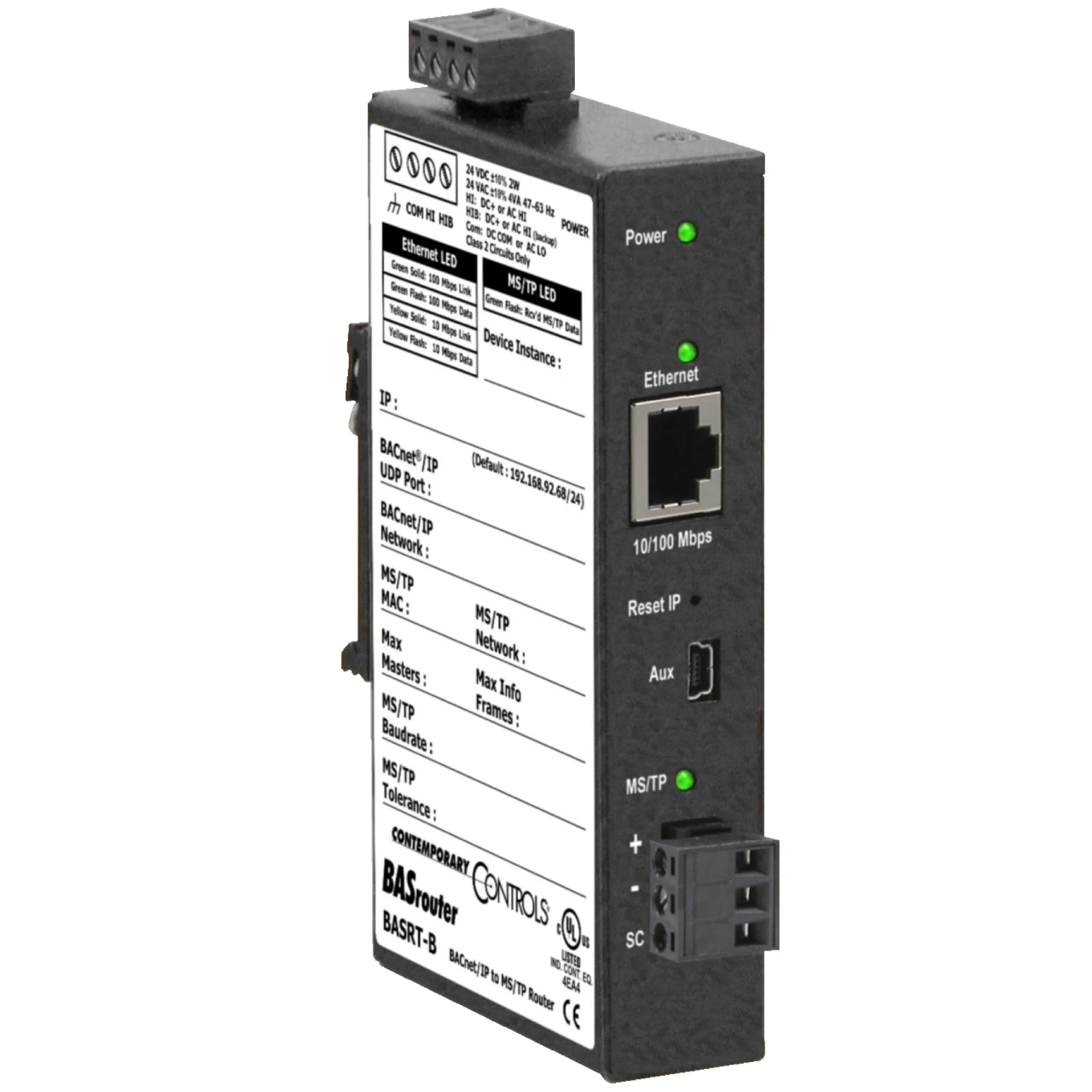


The Contemporary Controls BASRT-B BASrouter is a compact, BTL-Listed BACnet multi-network router that provides versatile stand-alone routing between BACnet/IP, BACnet MS/TP, and BACnet Ethernet (ISO 8802-3) networks - in any combination, including dual BACnet/IP UDP ports for NAT traversal. The BASRT-B is configured entirely through a built-in web server: no proprietary software, no licenses, no JACE required. Built-in BBMD and Foreign Device Registration support let BACnet broadcasts traverse subnetted IP networks, while a graphical MS/TP device status table (all 128 master addresses) and a discoverable BACnet routing table turn what is normally a black-box layer into something you can actually see and troubleshoot. The BASRT-B's optically-isolated MS/TP port, redundant power input, and -40°C to +75°C operating range make it equally at home in a clean automation closet or a rooftop mechanical penthouse.
› Versatile Multi-Network Routing
The BASRT-B routes simultaneously between BACnet/IP, BACnet Ethernet (ISO 8802-3), and BACnet MS/TP. Two BACnet/IP UDP ports support routing between two separate BACnet/IP networks - the technique behind NAT traversal for remote BACnet access over the public Internet. BBMD with up to 5 BDT entries and 5 FDR registrations is built in.
› Diagnostics That Actually Help
The BASRT-B's resident web server includes a graphical MS/TP device status table (Online / Router MAC / Offline color-coded for all 128 master addresses), per-network packet counters, MS/TP error count, MNSM state, token statistics, and a "Discover Routing Table" button that issues Who-Is-Router-To-Network across the internetwork. Reset IP button restores factory defaults.
| BASRT-B Specifications | |
|---|---|
| Model | BASRT-B |
| Manufacturer | Contemporary Controls |
| Product Family | BASrouter / BASautomation |
| Networks Routed | BACnet/IP, BACnet Ethernet (ISO 8802-3), BACnet MS/TP (in any combination) |
| BTL Profile | BACnet Router (B-RTR) and BACnet Broadcast Management Device (B-BBMD) |
| BACnet Protocol Revision | 13 |
| BIBBs Supported | DS-RP-B, DS-RPM-B, DM-DOB-B, DM-DDB-B, NM-RC-B, NM-BBMDC-B |
| Ethernet Port | 1 × Shielded RJ-45, 10/100 Mbps, IEEE 802.3, Auto-Negotiation, Auto-MDIX |
| Ethernet Cable Length | 100 m (max) CAT5 |
| MS/TP Port | 3-pin removable terminal block, optically-isolated EIA-485 |
| MS/TP Standard | ANSI/ASHRAE 135 (ISO 16484-5) |
| MS/TP Baud Rates | 9600, 19200, 38400, 76800 bps (selectable) |
| MS/TP Cable Length | 1200 m (max) |
| MS/TP Devices Supported | Up to 31 full-load (or 62 half-load) per segment, 254 total addresses |
| MS/TP Bias & Termination | Internal jumpers (default applied; removable for mid-span installation) |
| BBMD | Built-in; 5-entry Broadcast Distribution Table, 5-entry Foreign Device Table |
| NAT Traversal | Yes (dual BACnet/IP UDP ports) |
| Web Configuration | Resident HTTP server, any standard browser |
| Default IP / Subnet | 192.168.92.68 / 24 |
| Default Login | admin / admin (must be changed on first use) |
| Power Input | 24 VDC ±10%, 2 W or 24 VAC ±10%, 4 VA, 47-63 Hz |
| Power Connector | 4-pin removable terminal block (HIB / HI / COM / chassis); 16-18 AWG |
| Reverse-Polarity Protection | Yes |
| LEDs | Power, Ethernet (bi-color speed/activity), MS/TP (RX activity) |
| Operating Temperature | -40°C to +75°C (-40°F to +167°F) |
| Storage Temperature | -40°C to +85°C |
| Humidity | 10-95%, non-condensing |
| Protection | IP30 |
| Mounting | TS-35 DIN-rail (35 mm) |
| Dimensions (W × H × D) | 26 mm × 123 mm × 70 mm (1.00 in × 4.85 in × 2.74 in) |
| Enclosure | Metal, DIN-rail clip |
| Compliance | BTL Listed; UL 508 Listed, c-UL Listed (CSA C22.2 No. 142-M1987); CE Mark; CFR 47 Part 15 Class A; RoHS |
| Warranty | 5-year manufacturer warranty |
BASRT-B Product Documentation
BASrouter Data Sheet BASrouter Installation Guide BASrouter Application Guide (11 Routing Examples) Successful BASrouter Installation & Operation Troubleshooting BACnet Networks (Status Screen Tech Note)BASRT-B Application Notes & Compatibility
Using the BASrouter with an Alerton Controller Using the BASrouter with a Honeywell Spyder Controller Using the BASrouter with a Centraline Lynx Controller Using the BASrouter with a Trend IQ Controller Adding Cube I/O Modules to BACnet Spyder Controllers Using the BASrouter to Offload Your JACEBASRT-B - Frequently Asked Questions
What is the difference between the BASRT-B and the BASRT-B-U?
The BASRT-B and BASRT-B-U are functionally identical - same firmware, same routing capability, same BBMD/FDR support, same web interface, same hardware. The "-U" denotes the variant prepared for the United States market. Both carry UL 508 and c-UL Listings, CE Mark, and RoHS compliance per Contemporary Controls' published ordering information. Order BASRT-B-U for U.S. projects unless your specification or distributor indicates the BASRT-B specifically.
Does the BASRT-B require any proprietary software, licensing, or commissioning tool?
No. The BASRT-B is configured entirely through a built-in web server using any standard browser - point your laptop at the default IP address (192.168.92.68 / 24), log in with admin / admin, and configure both the BACnet/IP and MS/TP sides on a single page. There are no per-device licenses, no annual subscriptions, and no Niagara, Workbench, or vendor-specific software required. Default credentials must be changed on first use.
Which BAS controllers and head-ends has the BASRT-B been verified with?
Contemporary Controls publishes formal application notes covering the BASRT-B with Alerton MS/TP controllers, Honeywell Spyder VAV and unitary controllers, Centraline Lynx unitary and VAV controllers, Trend IQ controllers (including IQ3xcite), Tridium Niagara JACE (including JACE-3E), and BACnet Cube I/O expansion modules. Because the BASRT-B is BTL-Listed for the B-RTR profile and is a true BACnet standard router, it works with any BTL-Listed BACnet/IP head-end - including Niagara, Distech, Reliable Controls, Delta Controls, Schneider, Johnson Controls, Siemens, and others. See the application notes linked above for tested wiring and configuration details.
Can the BASRT-B share a 24 VAC transformer with my MS/TP controllers?
Yes - with one important caveat. The BASRT-B uses a half-wave rectified low-voltage power supply, so it can share a 24 VAC source only with other half-wave rectified devices (which is the vast majority of BAS field controllers, including Honeywell Spyder, Centraline Lynx, Alerton, and most Cube I/O modules). Do NOT share an AC source with full-wave rectified devices - mixing the two on a common transformer can damage equipment. The BASRT-B consumes 4 VA at 24 VAC or 2 W at 24 VDC. Verify total transformer VA capacity covers the combined load.
What is BBMD and when do I need to enable it on the BASRT-B?
BBMD (BACnet/IP Broadcast Management Device) lets BACnet broadcast messages traverse standard IP routers and firewalls, which by default block UDP broadcasts. Enable BBMD on the BASRT-B's Advanced screen only when your BACnet/IP devices are spread across multiple IP subnets or VLANs. For a single-subnet installation, leave BBMD disabled - turning it on unnecessarily causes the router to look for non-existent BBMDs and reduces traffic efficiency. The BASRT-B supports a 5-entry Broadcast Distribution Table and a 5-entry Foreign Device Table. For larger BBMD/FDR tables (50 entries each), see the BASrouterLX or BASrouterSX models.
How many MS/TP devices can I connect to a single BASRT-B?
EIA-485 supports 32 full-load devices per segment. The BASRT-B is one full-load device, leaving room for 31 more. If your field controllers use half-load (1/2 unit-load) or quarter-load (1/4 unit-load) transceivers - common with Honeywell, Centraline, and many newer controllers - you can attach up to 62 or 124 respectively, though Contemporary Controls recommends limiting any single MS/TP segment to about 45 devices for responsiveness. For larger networks, segment them across multiple BASRT-B units - each on its own MS/TP network number, all sharing one BACnet/IP backbone.
Can the BASRT-B offload MS/TP polling from my Niagara JACE?
Yes - and Contemporary Controls' published JACE offload application note demonstrates measured CPU reduction from 40-80% down to 20-40% on a JACE-3E polling 31 Alerton MS/TP devices at 10 points each. Connecting the JACE's MS/TP network through a BASRT-B (so the JACE communicates over BACnet/IP instead of directly polling MS/TP) frees up significant JACE CPU for histories, alarms, graphics, and logic - often allowing a smaller JACE or fewer JACEs on the project.
Does the BASRT-B support BTL listing and BACnet conformance?
Yes. The BASRT-B is BTL-Listed by BACnet International for the B-RTR (BACnet Router) and B-BBMD (BACnet Broadcast Management Device) Standardized Device Profiles, conforming to BACnet Protocol Revision 13. Supported BIBBs include DS-RP-B, DS-RPM-B, DM-DOB-B, DM-DDB-B, NM-RC-B, and NM-BBMDC-B. Full PIC Statement is included in the BASRT-B data sheet linked above.
Where should I install the BASRT-B on the MS/TP bus - end or middle?
End-of-line installation is preferred. The BASRT-B ships with internal 120-ohm termination and bias jumpers applied, so when installed at one end of the MS/TP segment, no external termination is needed at that end - just apply a 120-ohm terminator at the far-end device. For mid-span installation, open the BASRT-B case and remove the T (termination), U (pull-up bias), and D (pull-down bias) jumpers, then provide external bias and termination at both ends of the segment. Mid-span installation is generally not recommended.
Your BASRT-B BASrouter is backed by Contemporary Controls' five-year manufacturer warranty against defects in materials and workmanship from the original ship date. The BASRT-B is BTL Listed by BACnet International, UL 508 Listed and c-UL Listed (CSA C22.2 No. 142-M1987) for industrial control equipment, CE marked, and RoHS compliant for use in commercial, industrial, and international BAS projects.
- Sub-Category:
- BACnet Routers