

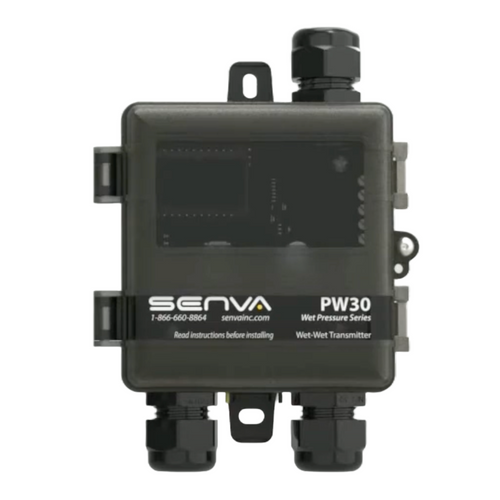
The Senva PW30W-C is part of the PW30 Series Remote Wet-to-Wet Differential Pressure Transmitter family - a revolutionary design that eliminates costly bypass plumbing by using remote sensors that mount directly to the pipe, eliminating bleeding, additional manifold plumbing, and the labor that comes with traditional bypass assemblies. This SKU is configured as a transmitter-only build with conduit knockouts for user-supplied 22 AWG 3-conductor shielded cable to the remote PWT sensors (which are ordered separately), housed in a PC/ABS, NEMA 4X / IP65 wall-mount enclosure with an integrated LCD display that toggles between Sensor A reading, Sensor B reading, and Differential (DP) reading. The transmitter supports 16 DIP-selectable differential pressure sub-ranges from 1 to 500 PSID on a single device, with switch-selectable output (0-5 VDC, 0-10 VDC, or 4-20 mA), uni- or bi-directional mode, fast/slow response averaging, port-swap correction, absolute-value mode, and manual or remote zeroing. Made in USA by Senva, Inc. at their facility in Beaverton, Oregon. This transmitter-only configuration is BABAA-compliant per Senva's 2026 Buy America / Build America Act / Trade Agreements Act conformance declaration - suitable for federal, ARRA, and government-funded HVAC projects with domestic-content requirements.
This Plastic NEMA 4X enclosure is best suited for humid or corrosive environments, wash-down areas, and coastal/chemical-exposure installations - watertight and corrosion-resistant (NEMA 4X) - hose-directed water, splashing, and corrosive atmospheres. Typical applications include hydronic loop demand measurement for pump speed control, chiller and heat exchanger delta-P monitoring, filter status monitoring, system leak detection, data center wet pressure sensing, and process control systems where flow measurement of liquids or gases compatible with 316L SS is needed. This is a transmitter-only configuration - you'll need to order PWT remote pressure transducers separately based on your application's maximum line pressure (50, 100, 250, or 500 PSIG ratings available).
Key Features
The PW30's signature innovation: remote PWT sensors mount directly on the pipe at each tap point, eliminating the need for bypass valve manifolds, brass plumbing fittings, copper impulse tubing, and the labor that comes with them. The mechanical trade installs the PWT sensors at the taps; the electrical trade installs the transmitter enclosure and runs the cable - fully independent installation paths, dramatically reducing total installed cost on retrofits and new construction.
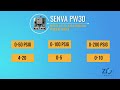
A single transmitter supports 16 differential pressure sub-ranges via DIP switches 4-7 (binary-coded): 0-1, 0-2, 0-5, 0-10, 0-15, 0-20, 0-25, 0-30, 0-40, 0-50, 0-75, 0-100, 0-125, 0-150, 0-250, and 0-500 PSID. The available accuracy depends on which PWT sensor pair is installed (see the Selectable Sub-Ranges table below). Drastically simplifies stocking - one transmitter SKU plus the right PWT pair covers nearly any HVAC pressure application.
A single OUTPUT slide-switch on the board selects between 0-5 VDC, 0-10 VDC, or 4-20 mA. One SKU works with any BAS controller - voltage outputs for short runs, 4-20 mA current loop for long runs or noisy environments. Reduces SKU complexity in spec packages.
The on-housing LCD toggles between Sensor A (high), Sensor B (low), and Differential (DP) readings. Tick marks at the top-left or bottom-left of the LCD indicate which value is currently shown; no mark means DP. An O/R icon flashes when the differential exceeds the selected sub-range. Engineering units are PSI or kPa, switchable via DIP 8.
PC/ABS housing rated NEMA 4X / IP65 - watertight and corrosion-resistant, suitable for wash-down areas, coastal installations, swimming pool mechanical rooms, and chemical-exposure environments where stainless or epoxy-coated steel would still corrode over time. For high-EMI environments near VFDs or motor starters, see the PW30M (metal NEMA 3R) variants.
Conduit knockouts on the enclosure for user-supplied 22 AWG 3-conductor shielded cable (Senva-recommended spec) to the remote PWT sensors. Connect water-tight conduit fittings if local code or installation conditions require. Cable shield terminates at the transmitter GND only (single-ended grounding prevents ground loops).
Twelve DIP switches configure every operational parameter without firmware tools: DIP 1-3 set the PWT sensor PSIG (50/100/250/500 or test mode), DIP 4-7 binary-encode the differential sub-range (16 options), DIP 8 selects PSI or kPa units, DIP 9 selects uni- or bi-directional mode, DIP 10 selects slow (64-sample averaging) or fast response, DIP 11 port-swap (corrects A/B miswiring without re-plumbing), and DIP 12 absolute-value mode.
Push-button on-board ZERO performs a custom zero-point calibration (hold 5 seconds until LCD blinks once). Hold 10 seconds until the LCD blinks twice to reset and clear the custom zero, restoring factory calibration. A remote ZERO terminal on the wiring block accepts an external momentary contact, useful for ground-floor zeroing of sensors mounted on penthouse equipment.
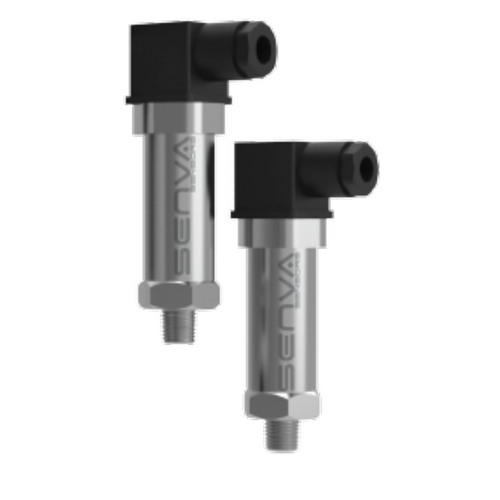
Each PWT remote pressure sensor uses a micro-machined silicon strain gauge behind a 316L stainless steel diaphragm in a 304 stainless body with 1/4" MNPT process fitting. Compatible with water, water/glycol, and any media compatible with 316 SS. Sensor accuracy is ±0.25% BFSL, stability is ±0.2% FS/year, with 200% over-range protection and a tested life of 100 million pressure cycles.
This transmitter-only configuration is manufactured in the USA with greater than 65% domestic content - meeting the thresholds for Buy America Act (49 USC 661.5(d)), Buy American Act (41 USC 10a), ARRA Section 1605, BABAA, and the Trade Agreements Act (TAA). Suitable for federal, ARRA-funded, and government-procurement HVAC projects with domestic-content requirements. Conformance declaration available on request.
Selectable Sub-Ranges (Depends on PWT Sensor)
The PW30 transmitter itself supports 16 differential pressure sub-ranges via DIP switches 4-7: 0-1, 0-2, 0-5, 0-10, 0-15, 0-20, 0-25, 0-30, 0-40, 0-50, 0-75, 0-100, 0-125, 0-150, 0-250, and 0-500 PSID. The achievable accuracy on each sub-range depends on which PWT sensor pair is paired with the transmitter. Order the matching PWT pair separately:
| PWT Pair | Max Line Pressure | 1% FSO Accuracy Ranges | 2% FSO Accuracy Ranges |
|---|---|---|---|
| PWT050 | 50 PSIG | 0-20, 0-25, 0-30, 0-40, 0-50 PSID | 0-10, 0-15 PSID |
| PWT100 | 100 PSIG | 0-40, 0-50, 0-75, 0-100 PSID | 0-15, 0-20, 0-25, 0-30 PSID |
| PWT250 | 250 PSIG | 0-75, 0-100, 0-125, 0-150, 0-250 PSID | 0-30, 0-40, 0-50 PSID |
| PWT500 | 500 PSIG | 0-150, 0-250, 0-500 PSID | 0-75, 0-100, 0-125 PSID |
Senva recommends matching the PWT PSIG rating to your maximum operating pressure - do not exceed the PSIG rating of the installed PWT sensors. Factory recommendation: do not use an output range less than 10% of the total PWT PSIG (accuracy degrades below this threshold).
Technical Specifications
| Specification | Detail |
|---|---|
| Sensor Style | Remote wet-to-wet differential pressure transmitter with dual remote PWT transducers |
| Measured Value | Differential pressure (Sensor A - Sensor B), with uni- or bi-directional mode |
| Sensor Element | Micro-machined silicon strain gauge with 316L stainless steel diaphragm |
| Media Compatibility | Water and any media compatible with 316 stainless steel |
| Fluid Temperature | 32 to 250 deg F (0 to 125 deg C). Steam applications require a pigtail siphon. |
| Selectable Sub-Ranges | 16 ranges via DIP 4-7: 0-1, 0-2, 0-5, 0-10, 0-15, 0-20, 0-25, 0-30, 0-40, 0-50, 0-75, 0-100, 0-125, 0-150, 0-250, 0-500 PSID |
| Sub-Range Filtering | Filtered by selected PWT sensor (50/100/250/500 PSIG) |
| Output Signal | Switch-selectable: 2-wire 4-20 mA, 3-wire 0-5 VDC, or 3-wire 0-10 VDC |
| PW Transmitter Accuracy (1% Ranges) | +/-1.0% FSO on the recommended ranges for each PWT (see range table) |
| PW Transmitter Accuracy (2% Ranges) | +/-2.0% FSO on lower portion of each PWT's range |
| PWT Sensor Accuracy | < +/-0.25% BFSL (includes non-linearity, hysteresis, repeatability) |
| Long-Term Stability | +/-0.2% FS, typical (1 year) |
| Pressure Cycles | > 100 Million |
| Over-Range Protection | 200% rated pressure |
| Temperature Compensation Range | 14 to 158 deg F (-10 to 70 deg C) |
| Power Supply (V output) | 12-30 VDC or 24 VAC at 20 mA max (13-30 VDC required for 0-10 V FS output) |
| Power Supply (mA output) | 15-30 VDC (0 ohm) / 16-30 VDC (250 ohm) / 18-30 VDC (500 ohm), 20 mA max |
| Zero Adjustment | Automatic + pushbutton (5 s = re-zero, 10 s = factory reset) + remote zero terminal |
| Response Mode (DIP 10) | Fast (most recent sample) or Slow (64-sample average) |
| Bi-Directional Mode (DIP 9) | Uni-directional or bi-directional output centered at mid-scale (12 mA / 5 V / 2.5 V at 0 PSID) |
| Port Swap (DIP 11) | Software swap of A/B inputs - corrects miswired sensors without re-plumbing |
| Absolute Mode (DIP 12) | Reports differential as absolute value (always positive) |
| Units (DIP 8) | PSI or kPa |
| Operating Temperature (Transmitter) | -22 to 158 deg F (-30 to 70 deg C) |
| Operating Humidity | 0 to 90% RH non-condensing |
| Vibration | 10G peak, 20-2000 Hz |
| Transmitter Enclosure | PC/ABS plastic, rated NEMA 4X / IP65 |
| PWT Sensor Construction | 304 stainless steel, 1/4" MNPT, PG9 conduit fitting |
| Cable / Connection | Conduit knockouts for user-supplied cable (22 AWG 3-conductor shielded recommended) |
| Remote Sensors | Not included - order PWT remote sensors separately (PWT050/100/250/500 available) |
| Approvals | CE, RoHS |
| Manufacturer | Senva, Inc. - Beaverton, Oregon, USA |
| Manufacturer Part Number | PW30W-C |
| Warranty | 7 years on transmitter electronics; 2 years on replaceable elements (PWT sensors, cables) |
| Domestic Content / BABAA | BABAA / Buy America / TAA compliant (transmitter only); bundles with PWT sensors are not BABAA compliant |
What's In the Box
- PW30W wall-mount transmitter enclosure (PC/ABS plastic, NEMA 4X / IP65) with integrated LCD display
- Conduit knockouts for user-supplied 22 AWG 3-conductor shielded cable
- Conduit adapters and terminal blocks (pre-assembled at PWT ends if cable included)
- Installation & Operation Instructions (Senva document 152-0412-0G)
- PWT remote pressure sensors - order separately (PWT050, PWT100, PWT250, or PWT500 based on max line pressure)
- Cable from transmitter to PWT sensors - Senva recommends 22 AWG 3-conductor shielded cable, installer-supplied
- PTFE thread tape or pipe compound for PWT NPT fittings (installer-supplied)
- Isolation valves at pipe taps (Senva offers the optional PWBV service valve)
- Power supply transformer and BAS controller wiring
Documentation
Frequently Asked Questions
What does the PW30W-C measure and output?
It measures the differential pressure between two physically separated tap points - Sensor A (high side) minus Sensor B (low side). The transmitter supports 16 DIP-selectable differential sub-ranges from 0-1 to 0-500 PSID. Output is one active analog signal, switch-selectable: 0-5 VDC, 0-10 VDC, or 4-20 mA. This SKU is the transmitter only; order the PWT sensor pair separately based on your maximum operating pressure (PWT050/100/250/500).
What's the advantage of the PW30's remote sensor architecture?
Traditional wet-to-wet DP transmitters require a bypass valve manifold, brass fittings, copper impulse tubing, and the labor to plumb both pressure points back to a single device body. The PW30 eliminates all of that: PWT sensors mount directly on the pipe at each tap point and connect to the wall-mount transmitter via a single cable. The mechanical and electrical trades can install independently - dramatically reducing total installed cost and shortening the critical path on retrofit projects.
When should I choose the PW30W (plastic) versus the PW30M (metal)?
Choose the PW30W (plastic NEMA 4X) for wash-down areas, humid or corrosive environments, swimming pool mechanical rooms, and coastal/chemical-exposure installations where metal enclosures would corrode over time. Choose the PW30M (metal NEMA 3R) for indoor mechanical rooms with high-EMI equipment nearby (VFDs, large motor starters) - the powder-coated steel housing provides better EMI/RFI shielding.
When do I use bi-directional mode (DIP 9)?
Uni-directional (DIP 9 = ON, factory default) is correct for almost all HVAC applications where Sensor A is always at higher pressure than Sensor B (pump head monitoring, filter loading, chiller delta-P, system pressure drop). Bi-directional (DIP 9 = OFF) is required when flow can reverse - reversible-flow heat recovery loops, dual-pump systems with auto-changeover, or balance work where the operating sense flips between modes. In bi-directional mode, 0 PSID = 50% of output range (12 mA, 5 V, or 2.5 V depending on output type).
How are the 16 sub-ranges selected?
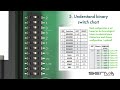
DIP switches 4-7 binary-encode the sub-range: 0000 = 0-1 PSID, 0001 = 0-2 PSID, 0010 = 0-5 PSID, ..., 1111 = 0-500 PSID. Binary reads right to left - RANGE0 is the rightmost bit (DIP 7), RANGE3 is the leftmost (DIP 4). Example: DIP 4=1, 5=0, 6=1, 7=1 = binary '1011' = 0-100 PSID. Power must be OFF when changing DIP switches; new settings take effect only on power-up. DIP 1-3 set the PWT sensor PSIG (must match the installed PWT pair).
What does the Port Swap (DIP 11) feature do?
If Sensor A was accidentally plumbed to the low-pressure side and Sensor B to the high-pressure side, DIP 11 = LEFT (B-A) swaps the inputs in software - no need to re-plumb. This is one of the most useful field features on the PW30 - it catches a common installation error (especially on retrofits where existing taps weren't clearly labeled) and resolves it with a single DIP switch.
How do I zero the device?
Custom zero: ensure both PWT sensors are at equal pressure (typically shut isolation valves and bleed to atmosphere), wait at least 10-15 minutes for warm-up, then hold the ZERO button for 5 seconds until the LCD blinks once. Factory reset: hold the ZERO button for 10 seconds until the LCD blinks twice - this clears the custom zero and restores factory calibration. A remote ZERO terminal accepts an external momentary contact for ground-floor zeroing of elevated installations.
Is this product BABAA / Buy America / TAA compliant?
Yes - this is a transmitter-only configuration without PWT remote sensors. Senva's 2026 BABAA/TAA/ARRA Conformance Declaration explicitly lists 'PW30W-C, PW30M-C, PW30 versions not including PWT transducers' as meeting the domestic-content thresholds for Buy America Act (49 USC 661.5(d)), Buy American Act (41 USC 10a), ARRA Section 1605, BABAA, and the Trade Agreements Act. Suitable for federal and government-funded HVAC projects. Compliance declaration available on the Documentation tab.
What media can this sensor handle?
Water and any media compatible with 316 stainless steel (the PWT sensor diaphragm is 316L SS, the body is 304 SS, 1/4" MNPT process fitting). Typical HVAC: water, water-glycol mixtures, refrigerants, light oils. Fluid temperature at the PWT must stay 32-250 deg F (0-125 deg C). Steam applications require a pigtail siphon ahead of the PWT to cool the media below the sensor's max - condensate sitting in the siphon thermally decouples the live steam from the sensor diaphragm.
What's the warranty?
7 years on the PW transmitter electronics and 2 years on all replaceable elements (PWT remote sensors, cable harnesses, valve manifolds). This is one of the longest electronics warranties in the HVAC sensor category - Senva backs the 7-year warranty with US-based manufacturing and domestic technical support. ZOT Supply is an authorized Senva distributor; warranty claims are processed directly with Senva.
- Series:
- PW30
- Pressure Type:
- Differential
- Media:
- Wet
- Bypass:
- None
- Output Signal:
- 4-20mA, 0-5 VDC, 0-10 VDC
- Display:
- LCD Display
- Enclosure:
- NEMA 4X
- Cable:
- Conduit Connection
- Remote Sensors:
- Not Included