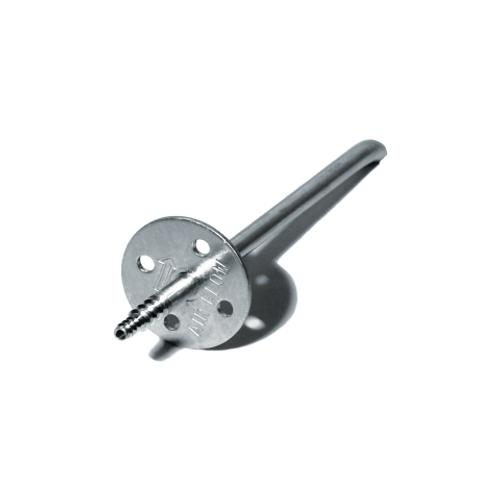


The ACI VPT-8" is an aluminum velocity pressure (impact) probe with a 8.0 in (203.2 mm) insertion length — used to sample air flow velocity in HVAC ducts or equipment. Unlike static probes (such as the ACI SPT) which open parallel to the air stream, the velocity probe is mounted with the tip facing directly into the air stream (a mounting arrow on the probe shows orientation). The probe measures total pressure (static + dynamic), which is then differenced against a static reference to compute air velocity and flow rate.
Mount approximately 5 to 8 duct diameters downstream from elbows, obstructions, or large duct-area changes to reduce turbulence. The 1.50 in flange has four 3/16 in mounting holes for screw or rivet fastening; a 3/8 in hole in the duct accepts the 1/4 in probe body. Six barbed tubing connection points on the flange accept 1/8 in through 1/4 in ID flexible plastic tubing. Probe mounting angle is parallel to the air stream (+/-7 deg) — meaning the probe shaft can deviate up to 7 degrees from perfect alignment with the flow direction without significantly affecting accuracy.
Air flow / velocity measurement in larger HVAC ducts and main duct runs where the probe tip must reach closer to the duct centerline for representative velocity sampling. Fan operation verification, true air flow monitoring, and main-duct velocity measurement in non-critical applications.
Key Features
The probe tip is mounted directly into the air stream (a mounting arrow on the probe shows orientation). Measures total pressure (static + dynamic) for use in computing air velocity and flow rate — the standard arrangement for true air flow monitoring vs. simple static / filter monitoring.
Solid aluminum probe body with 8.0 in (203.2 mm) insertion length and 1/4 in (6.35 mm) outside diameter. Aluminum gives long service life, resistance to typical duct conditions, and the rigidity needed for mid-duct mounting.
Probe mounting angle is parallel to the air stream within +/-7 degrees — meaning the probe shaft can deviate up to 7 degrees from perfect alignment with flow direction without significantly affecting velocity readings. The mounting arrow on the probe shows correct flow direction.
The 1.50 in (38.1 mm) flange has six 45 deg barbed tubing fittings. Accepts 1/8 in through 1/4 in ID flexible plastic tubing — compatible with ACI medical-grade tubing kits and any standard pneumatic tubing of equivalent quality.
Storage and operating temperature -40 to 185 deg F (-40 to 85 deg C). Total weight just 0.034 lb (15.4 g) — minimal impact on duct integrity. RoHS2, WEEE, and REACH compliant.
Technical Specifications
| Specification | Value |
|---|---|
| SKU | VPT-8" |
| Series | Velocity Pitot Tube |
| Probe Type | Velocity / Impact |
| Tubing Connection | 45 deg barbed type (6 places), accepts 1/8 in through 1/4 in ID flexible plastic tubing |
| Probe Insertion Length | 8.0 in (203.2 mm) |
| Sensing Points | 1 (single point) |
| Tube Mounting Direction | Tip opens directly into the air stream (mounting arrow on probe) |
| Impact Tube Mounting Angle | Parallel to air stream (+/-7 degrees) |
| Mounting Flange Diameter | 1.50 in (38.1 mm) |
| Measurement Probe Hole Size | 1/4 in (6.35 mm) |
| Mounting Holes Diameter | 3/16 in (4.76 mm) |
| Material | Aluminum |
| Storage & Operating Temperature | -40 to 185 deg F (-40 to 85 deg C) |
| Operating Humidity | 0 to 90% RH non-condensing |
| Weight | 0.034 lb (15.4 g) |
| Agency Approvals | RoHS2, WEEE, REACH |
| Warranty | 5-year ACI Limited Warranty |
What’s In the Box
- ACI VPT-8" Aluminum Velocity Pitot Tube (8.0 in insertion length)
- Installation instructions (also available below as PDF)
Recommended Companion Products
The VPT-8" requires 1/8 to 1/4 in ID flexible plastic tubing to connect to a differential pressure transmitter. ACI medical-grade tubing kits in four lengths:
Same velocity pitot tube in the other insertion length:
Documentation
Frequently Asked Questions
The VPT-8" measures total pressure (static plus dynamic) in an HVAC duct, which is then differenced against a separate static reference to compute air velocity and flow rate. Unlike static probes (ACI SPT) which open parallel to the air stream and measure static pressure only, the velocity probe is mounted with the tip facing directly into the air stream. Use the velocity probe for true air flow measurement; use the static probe for filter-status, fan-operation, or duct static monitoring.
Pick the VPT-8" (8 in / 203.2 mm) for larger main-duct installations where the probe tip should reach closer to the duct centerline for representative velocity sampling, or installations where the duct wall is thicker (insulated, double-wall) and more probe length is needed. For small branch ducts or compact equipment, the standard VPT (4 in / 101.6 mm) is the better choice.
Velocity in a duct is calculated from velocity pressure — the difference between total pressure (what the velocity probe measures) and static pressure (the pressure component independent of flow). To compute velocity, the differential pressure transmitter needs both inputs: the velocity probe on the high port, and a static reference (either a separate static pitot tube like the ACI SPT, or a wall tap in the duct) on the low port. The transmitter's differential reading is then converted to FPM via the duct's flow coefficient.
Approximately 5 to 8 duct diameters downstream from elbows, obstructions, transitions, or other large changes in duct area — this places the probe where turbulence has settled out and the velocity reading is most representative. Drill a 3/8 in hole, insert the probe through until the flange is tight to the duct, fasten the flange with four #8 x 3/4 in TEK screws (not included), and confirm the mounting arrow on the probe points in the direction of air flow (probe tip facing upstream into the flow).
The probe accepts 1/8 in through 1/4 in ID flexible plastic tubing. For long runs, 1/4 in tubing minimizes pressure drop in the line. ACI offers FDA-compliant medical-grade flexible PVC tubing kits in 10 ft, 20 ft, 50 ft, and 100 ft lengths. Keep the run as short as practical to minimize response time; avoid sharp bends and low points where condensation can collect.
Any low-DP differential pressure transmitter that accepts 1/8 to 1/4 in flexible tubing on both the high- and low-pressure ports — including ACI's own DLP and MLP2 series, BAPI ZPM zone pressure multi-sensors, Dwyer's 600- and 700-series differential transmitters, Senva pressure transmitters, and most other manufacturers' low-DP air pressure transmitters. For velocity / flow measurement specifically, the transmitter must support the velocity-pressure-to-FPM conversion (most modern BAS-compatible transmitters do; older simple DP gauges may not).