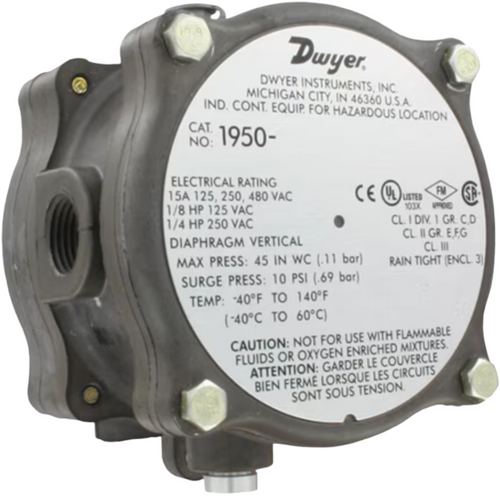


The Dwyer 1950P-8-2F is a Series 1950 Explosion-Proof Differential Pressure Switch — a single-setpoint pressure switch in an explosion-proof, weatherproof cast aluminum housing, calibrated for an adjustable setpoint anywhere within 1.5 to 8 psi. Built for use in hazardous locations where ignition risk requires explosion-proof enclosures: UL and CSA listed and FM approved for Class I Groups C and D; Class II Groups E, F, and G; and Class III atmospheres. Also CE compliant.
The 1950 design solves a common explosion-proof switch installation headache: the setpoint adjustment screw is on the outside of the housing. You can recalibrate or trim the setpoint without opening the explosion-proof enclosure — no cover removal, no purging required, no risk of contaminating or de-rating the housing seal. A captive screw lets the top cover swing aside (still attached) when electrical access is needed for wiring.
The housing is rain-tight to NEMA 3 / IP54 for outdoor installations, and is rated NEMA 7 and 9 for the hazardous-area classifications above. Switch is a single SPDT (Form C) relay with COM/NO/NC terminals on an internal terminal block, rated 15 A @ 125, 250, or 480 VAC (60 Hz); 1/8 HP @ 125 VAC; 1/4 HP @ 250 VAC. The unit is very compact and lightweight — 3.25 lb (1.5 kg), about half the weight and bulk of equivalent conventional explosion-proof pressure switches with separate enclosures.
Higher-pressure differential or gauge pressure alarming/control in hazardous locations — pressurization control, filter status, pump discharge monitoring, compressor system alarms, and process pressure interlocks in the 1.5 to 8 psi range. Hazardous-area approvals cover Class I Groups C and D (common for hydrocarbon process areas), Class II Groups E, F, G (dust areas), and Class III. Also suitable for outdoor weather-exposed installations.
For use with air or non-combustible compatible gases only. Do NOT connect explosive media to the LOW PRESSURE port (including differential pressure applications involving combustible gas on the low side). Internal switch contact arcing in the presence of combustible gas inside the housing can cause an internal explosion — the explosion-proof housing will contain the event, but the switch will be rendered inoperative. For single positive pressure sensing against atmosphere in hazardous areas, vent the LP port through tubing to a non-hazardous location.
Key Features
UL and CSA listed, FM approved for Class I Groups C, D; Class II Groups E, F, G; and Class III hazardous locations. Rated NEMA 3 (IP54), NEMA 7, and NEMA 9 — rain-tight for outdoor use plus explosion-proof for indoor hazardous areas, all in one cast aluminum housing. About half the weight and bulk of equivalent explosion-proof switches with separate enclosures (3.25 lb / 1.5 kg total). CE compliant.
The setpoint adjustment screw is mounted on the outside of the housing — turn the slotted screw clockwise to raise the setpoint, counterclockwise to lower. No need to open the explosion-proof cover for calibration, eliminating the risk of contaminating the seal or de-rating the enclosure. A protective plastic cap covers the adjustment screw when not in use.
Field-adjustable setpoint anywhere within 1.5 to 8 psi. Approximate deadband is 1.0 psi at minimum setpoint, 1.0 psi at maximum setpoint. Use a manometer of known accuracy in a T-fitted calibration setup to verify the actual trip pressure during installation.
1 single-pole double-throw (SPDT) Form C relay with COM, N.O., and N.C. terminals on an internal terminal block. Rated 15 A @ 125, 250, or 480 VAC (60 Hz); resistive 1/8 HP @ 125 VAC, 1/4 HP @ 250 VAC. Power supply options include 24 VDC, 120 VAC, or 240 VAC. Mica-silver and phenolic-silver contacts standard.
When wiring access is needed, remove three hex-head screws and loosen the fourth captive screw - the cover swings aside while staying attached to the unit (no dropped covers, no lost hardware). Electrical conduit enters through a 1/2 in female NPT connection. Vent drain plug at the bottom can be rotated periodically to dislodge any condensation buildup. External ground lug for bonding to the conduit system.
Mounting via two 17/64 in (6.75 mm) holes on a 4-7/8 in (123.83 mm) bolt circle — bracket-mounts to walls, structural members, or panels. Pressure connections are two 1/8 in female NPT ports (HIGH and LOW). Diaphragm must be mounted vertical (with the Dwyer nameplate upright) for the published calibration to hold; consult factory for other mounting orientations.
Technical Specifications
| Specification | Value |
|---|---|
| SKU | 1950P-8-2F |
| Series | Dwyer Series 1950 Explosion-Proof |
| Product Type | Single-Setpoint Differential Pressure Switch (Explosion-Proof) |
| Setpoint Operating Range | 1.5 to 8 psi |
| Approximate Deadband at Min Setpoint | 1.0 psi |
| Approximate Deadband at Max Setpoint | 1.0 psi |
| Service | Air and non-combustible, compatible gases |
| Wetted Materials | Consult factory |
| Diaphragm | Buna-N (2F standard configuration) |
| Temperature Limits | 0 to 140 deg F (-17.8 to 60 deg C) |
| Pressure Limits | 35 psi (2.41 bar) continuous; 50 psi (3.45 bar) surge |
| Switch Type | Single-pole double-throw (SPDT), Form C |
| Electrical Rating | 15 A @ 125, 250, 480 VAC, 60 Hz; resistive 1/8 HP @ 125 VAC; 1/4 HP @ 250 VAC |
| Contact Materials | Mica silver and phenolic silver (STD) |
| Electrical Connections | Internal screw-type terminal block: COM, N.O., N.C. |
| Electrical Conduit | 1/2 in female NPT |
| Process Connections | 1/8 in female NPT (high and low pressure ports) |
| Setpoint Adjustment | External slotted screw on top of housing (plastic protective cap) |
| Mounting Orientation | Diaphragm in vertical position (consult factory for other orientations) |
| Mounting Pattern | Two 17/64 in (6.75 mm) holes on a 4-7/8 in (123.83 mm) bolt circle |
| Enclosure Rating | NEMA 3 (IP54) rain-tight, NEMA 7, NEMA 9 |
| Hazardous Location Listings | UL listed; CSA listed; FM approved — Class I Groups C and D; Class II Groups E, F, G; Class III |
| Compliance | CE, UL, CSA, FM |
| Response Time Note | Flame arrestor restriction may extend response time to 10-25 seconds when applied pressure is near setpoint |
| Housing Material | Cast aluminum |
| Weight | 3.25 lb (1.5 kg) |
| Vent Drain Plug | Yes, with O-ring seal (rotate periodically to dislodge condensation) |
| Field Serviceability | Not field-serviceable - return to Dwyer for repair |
| Country of Origin | USA |
What’s In the Box
- Dwyer 1950P-8-2F Series 1950 Explosion-Proof Differential Pressure Switch
- Cast aluminum housing with O-ring seal in cover (rain-tight NEMA 3 / IP54)
- External setpoint adjustment screw with plastic protective cap
- Vent drain plug (pre-installed at bottom of housing)
- External ground lug for conduit bonding
- Installation and operating instructions (also available below as PDF)
- Note: Mounting hardware (bolts/brackets) and electrical conduit fittings NOT included - specify separately based on installation
Related Products
Adjacent ranges in this family: smaller: 0.5 to 2 psi; larger: 3 to 15 psi.
Documentation
Frequently Asked Questions
The 1950P-8-2F is a Series 1950 Explosion-Proof Differential Pressure Switch with a single setpoint adjustable anywhere within 1.5 to 8 psi. When applied pressure crosses the setpoint, an internal SPDT relay actuates (N.O. closes, N.C. opens). It resets when pressure drops below setpoint minus deadband (1.0 psi at min setpoint, 1.0 psi at max).
UL listed, CSA listed, FM approved for: Class I Groups C and D (hydrocarbon vapors); Class II Groups E, F, G (combustible dusts); Class III (combustible fibers). Also NEMA 7 (explosion-proof), NEMA 9 (dust-ignition-proof), and NEMA 3 / IP54 rain-tight for outdoor use. CE compliant. Note: the standard 1950 is NOT ATEX/IECEx approved — for ATEX and natural gas compatibility, see the 1950G.
Remove the plastic cap covering the adjustment screw on top of the housing. Turn clockwise to raise setpoint, counterclockwise to lower, then replace cap. The explosion-proof cover stays closed — no purging or seal disturbance needed. For accurate calibration, use a T-fitted manometer of known accuracy and approach setpoint slowly to identify the actual trip pressure.
Air and non-combustible compatible gases only. The explosion-proof housing protects the surrounding environment, but Dwyer specifically warns against connecting explosive media to the LOW pressure port — switch contact arcing in the presence of combustible gas inside the housing can ignite it. The explosion is contained, but the switch is destroyed. For natural gas service, use the Series 1950G instead. For single positive pressure sensing in hazardous areas, run a vent line from the LP port to a non-hazardous location.
Remove three hex-head screws, loosen the fourth captive screw, swing cover aside (stays attached). Wire to internal terminal block: COM, N.O., N.C. (N.O. closes when pressure rises through setpoint). Conduit enters through 1/2 in female NPT; external ground lug provided. Max 15 A resistive; Dwyer recommends limiting to 10 A in high-ambient-temp, inductive-load, or fast-cycling applications to extend contact life.
Slower than non-hazardous switches — the flame arrestors required for the explosion-proof rating restrict airflow into the diaphragm chamber. Response time can be 10 to 25 seconds when applied pressure is near setpoint. For sub-second response needs, this switch is not suitable — consider a non-hazardous-area switch or transmitter if explosion-proof rating is not required.
Two mounting holes on the back: 17/64 in (6.75 mm) on a 4-7/8 in (123.83 mm) bolt circle. Field-supplied 1/4 in bolts attach to wall, panel, or bracket. Diaphragm must be vertical with Dwyer nameplate upright — other orientations require factory recalibration. Operating temp range: 0 to 140 deg F (-17.8 to 60 deg C).
Two 1/8 in female NPT ports: HIGH and LOW. Use 1/4 in OD metal tubing. Differential pressure: higher source to HIGH, lower to LOW. Gauge pressure: source to HIGH, LOW open to atmosphere. Vacuum: source to LOW, HIGH open to atmosphere. In hazardous areas, never leave LP port open to combustible-gas atmosphere — route to a non-hazardous location.