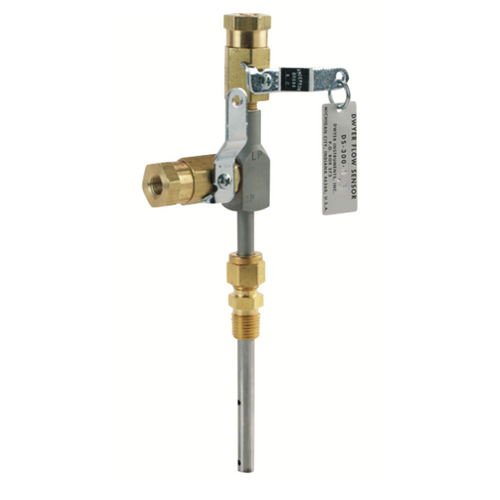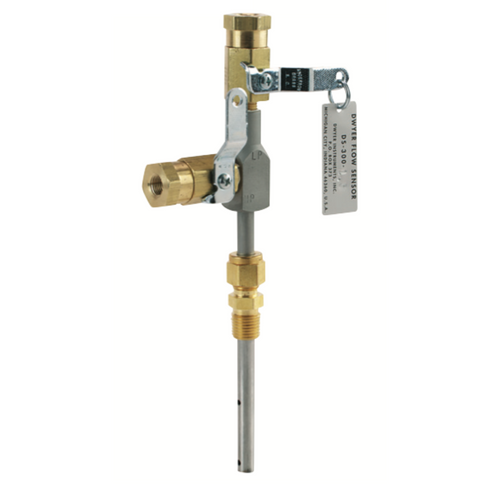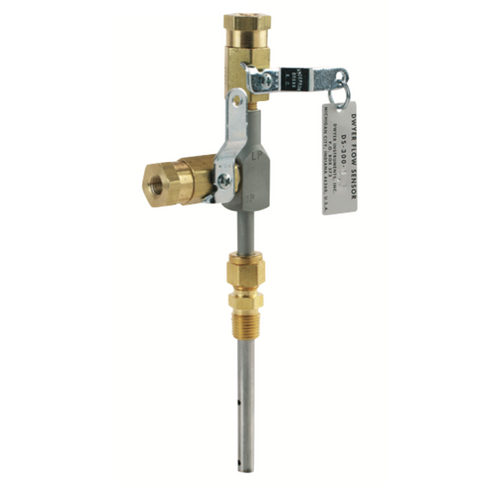


The Dwyer DS-300-10-LV is a Series DS-300 In-Line Flow Sensor designed for installation in 10" schedule 40 pipe. The DS-300 is an averaging Pitot tube design with multiple sensing ports along the probe length — eliminating the need to traverse the flowing stream with a single-point velocity probe. Multiple upstream and downstream ports, sized and positioned along a 304 stainless steel sensor tube, provide effective averaged pressure readings even at lower velocities.
The sensor is inserted into the pipeline through a 1/4 in male NPT brass compression fitting (included), then pairs with any compatible Dwyer Magnehelic® (air flow) or Capsuhelic® (liquid flow) differential pressure gage — or any other differential pressure transmitter or gage with appropriate range. The result is a flow-indicating system delivered off the shelf at an economical price. For a 10" schedule 40 host pipe, the flow coefficient is K = 0.70; this is the -LV (less valves) variant — the same flow sensor without the integrated isolation valves, for installations where zeroing isolation isn't required or where external manifold valving is preferred.
Economical in-line flow measurement in 10" schedule 40 host piping carrying water, steam, air, natural gas, flue or stack gases, boiler feedwater, cooling water, combustion or compressed air, oil, and other compatible fluids. HVAC chilled / hot water loops, light industrial process lines, building services metering, and remediation applications where averaging Pitot accuracy is sufficient.
Key Features
Multiple upstream and downstream sensing ports along the probe length — sized and positioned to provide effective accurate pressure averaging even at lower velocities. Eliminates the need to traverse the flowing stream with a single-point velocity probe, saving installation and commissioning time. Proven, reliable Pitot technology used in flow measurement for decades.
Flow coefficient K = 0.70 calibrated for use in 10-inch schedule 40 pipe — the constant used in the Dwyer flow equations to convert measured differential pressure (in inches W.C.) to flow rate (GPM for liquids, SCFM for gases, lb/Hr for steam). Refer to bulletin F-50 for the complete equation set.
304 stainless steel sensor tube with machined stainless steel head and brass packing gland compression fitting. Standard valves (when included) are brass with TFE seat and Buna-N O-ring, rated 200 psig at 200 deg F. Stainless permanently-attached nameplate with split ring includes complete size and model information.
This -LV variant ships without integrated isolation valves at reduced cost. Appropriate for installations using external 3-valve manifolds for isolation and zeroing, or for applications where in-line valving isn't required. The 1/8 in female NPT pressure connections remain the same — valves can be field-added if needed.
Designed for compatible gases or liquids including water, steam (superheated, saturated, or geothermal), air (combustion, compressed, flue, stack, natural, flare), boiler feedwater, cooling water, and oils. Wetted materials: 304 SS sensor tube; brass compression fitting. Pressure limit 200 psig (13.78 bar) at 200 deg F (93.3 deg C).
Mounting orientation matters: for air or gas flow, install the sensor in the upper quadrant of the pipe (so condensate drains back to the pipe). For liquid or steam flow, install in the lower quadrant (so air bleeds back to the pipe). The side connection is high pressure (HP) and should be pointed upstream; the top connection is low pressure (LP).
Technical Specifications
| Specification | Value |
|---|---|
| SKU | DS-300-10-LV |
| Series | DS-300 |
| Product Class | Averaging Pitot In-Line Flow Sensor |
| For Host Pipe Size | 10" |
| Host Pipe Schedule (K Factor Calibration) | Schedule 40 |
| Flow Coefficient (K) | 0.70 |
| Service | Compatible gases or liquids |
| Sensor Tube Material | 304 Stainless Steel |
| Compression Fitting Material | Brass |
| Process Connection | 1/4 in male NPT compression fitting (brass packing gland, included) |
| Instrument (Piping) Connections | 1/8 in female NPT |
| Valve Configuration | No integrated valves (-LV configuration) |
| Valve Rating | N/A (no valves) |
| Adapters Included | None |
| Pressure Limit | 200 psig (13.78 bar) at 200 deg F (93.3 deg C) |
| Temperature Limit | 200 deg F (93.3 deg C) |
| Air Operating D/P Range (at 60 deg F, 14.7 psia) | 0.17 to 22 in W.C. |
| Water Operating D/P Range (at 70 deg F) | 0.60 to 79 in W.C. |
| Velocity Range Not Recommended (vibration) | 6.4 to 10 ft/s |
| Recommended Upstream (one elbow/tee, in-plane) | 7 diameters |
| Recommended Upstream (all valves) | 24 diameters |
| Recommended Downstream | 5 diameters |
| Head Dimensions | 1-15/16 in (49.21 mm) x 1-3/4 in (44.45 mm) overall head |
| Compatibility Range | 1 in to 10 in schedule 40 pipe |
| Agency Markings | USA: California Proposition 65 (Lead) |
| Warranty | Dwyer manufacturer warranty |
What’s In the Box
- Dwyer DS-300-10-LV DS-300 Averaging Pitot Flow Sensor (for 10" schedule 40 host pipe, K = 0.70)
- 1/4 in male NPT brass compression fitting (packing gland) - pre-installed
- Stainless steel nameplate with split ring (model and size information)
- Installation and operating instructions (also available below as PDF)
Related Products
the with-valves (standard) variant of the same flow sensor — includes integrated brass quarter-turn ball valves on both pressure connections for sensor zeroing isolation.
Other DS-300 flow sensors for adjacent pipe sizes:
For 10 in pipe with higher flow rates or where extra-strong 3/4 in diameter construction is preferred, see the heavier-duty DS-400 variant:
Documentation
Frequently Asked Questions
The DS-300-10-LV is a Series DS-300 averaging Pitot tube flow sensor designed for installation in 10" schedule 40 host pipe. It develops a differential pressure proportional to the square of the flow rate through the pipe — that differential is then read by a Dwyer Magnehelic® (air), Capsuhelic® (liquid), or any other compatible differential pressure gage or transmitter, and converted to flow rate via the Dwyer flow equations using K = 0.70 (the flow coefficient calibrated for the inside diameter of 10" schedule 40 pipe). The sensor itself is built from a 304 stainless steel sensor tube with a brass compression fitting; suitable for water, steam, air, gases, oils, and other compatible fluids.
The sensor is not made from schedule 40 pipe. The sensor body is built from 304 stainless steel (sensor tube) and brass (compression fitting). “Schedule 40” refers to the host piping this sensor is calibrated to drop into — the flow coefficient K = 0.70 is based on the inside diameter of 10" schedule 40 pipe. If you install this sensor into a non-schedule-40 pipe of the same nominal size, the actual inside diameter will be different and the K factor won't be accurate as-published; the formulas in Bulletin F-50 use the actual internal diameter D, so you'd need to recalculate.
Pick the DS-300 for pipe sizes 1 in to 10 in with standard flow rates and light-to-medium duty applications — HVAC chilled/hot water, building services metering, light industrial process. The DS-300 uses a 1/4 in male NPT compression fitting and is the economical choice when extra-strong construction isn't required. Pick the DS-400 for larger pipes (6 in to 24 in) or applications with higher flow rates where increased forces on the probe require the DS-400's 3/4 in diameter stainless steel construction. For overlapping sizes (6 in, 8 in, 10 in), choose based on duty severity and budget.
-LV (less valves) means this sensor ships without the integrated brass quarter-turn ball valves that are standard on the with-valves model. Choose -LV when (1) you'll use an external 3-valve manifold for isolation and zeroing, (2) the application doesn't require in-service gage zeroing, or (3) you have valves on hand to field-install. Order the DS-300-10 (with-valves) instead if you want isolation built into the sensor body for convenient in-place zeroing.
Use the Dwyer flow equations (from Bulletin F-50). For any liquid: Q (GPM) = 5.668 x K x D² x sqrt(ΔP / Sf). For steam or any gas: Q (lb/Hr) = 359.1 x K x D² x sqrt(p x ΔP). For any gas (SCFM): Q (SCFM) = 128.8 x K x D² x sqrt(P x ΔP / ((T+460) x Ss)). Where K = 0.70 for this pipe size, D is the internal pipe diameter in inches, ΔP is the measured differential pressure in inches W.C., and the other terms are media properties (Sf = specific gravity at flow conditions, p = density in lb/ft³, P = static line pressure in psia, T = temperature in deg F, Ss = specific gravity at 60 deg F).
For air at 60 deg F and 14.7 psia (standard conditions), the recommended differential pressure operating range is 0.17 to 22 in W.C. For water at 70 deg F, the recommended D/P range is 0.60 to 79 in W.C. Velocity ranges to avoid (continuous operation in these ranges can cause vibration damage to the sensor): 6.4 to 10 ft/s. For other gases, liquids, or operating conditions, consult Dwyer for recommended operating ranges.
Dwyer's rule of thumb is 10 to 15 pipe diameters upstream and 5 downstream. Specific minimums depend on what's upstream of the sensor: 7 diameters for one elbow or tee in-plane (9 out-of-plane); 8 diameters for two 90 deg bends in same plane (12 out of plane); 18 diameters for two 90 deg bends in different planes (24 out of plane); 8 diameters for reducers or expanders; and 24 diameters for all valves (partially open). For laboratory or high-accuracy work, add 25% to these values. Control valves should always be located after the flow sensor, never before it.
For air or gas flow: install the sensor in the upper quadrant of the pipe so that any condensate drains back to the pipe (and not into the instrument tubing). For liquid or steam flow: install in the lower quadrant so any air bleeds back to the pipe (and not into the gage). In both orientations, the side connection on the sensor head is high pressure (HP) and should be pointed upstream; the top connection is low pressure (LP). Connect HP to the gage's high port, LP to the gage's low port.
The differential pressure side of any Dwyer (or equivalent third-party) differential pressure gage or transmitter with appropriate range. Standard pairings: Dwyer Magnehelic® for air flow (mechanical D/P gage, multiple ranges); Dwyer Capsuhelic® for liquid flow (rugged mechanical D/P gage rated up to 500 psig line pressure); Dwyer Series 605, 616, or 629 transmitters for electronic 4-20 mA output to a BAS. The Dwyer A-471 Portable Capsuhelic® Gage Kit pairs with the SAE 45 flared adapter ports (included on DS-400 with-valves models; optional on DS-300) for portable flow surveying.