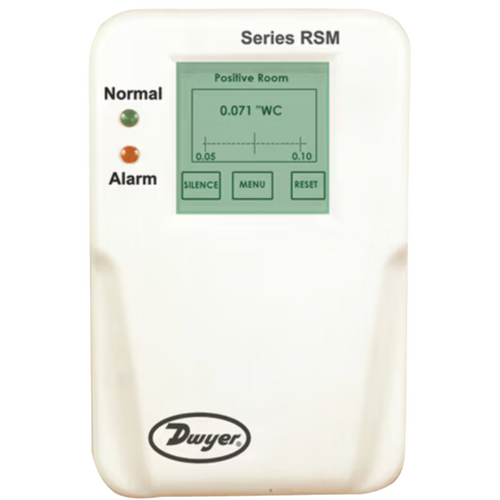


The Dwyer RSM-6-B is a Room Status Monitor designed for critical low-differential-pressure applications that require continuous pressure monitoring, audible and visual alarming, and password-protected configuration. The Series RSM is a complete wall-mounted system — capacitive differential pressure sensor, backlit RGB LCD touchscreen, audible buzzer, status LEDs, alarm relay, and field-selectable analog output — engineered to monitor positive or negative room pressure in protected environments and hospital isolation rooms per CDC guidelines.
The RSM-6-B measures a bipolar range of ±2.5 in w.c. — sized for wider-DP applications including animal facilities, pharmaceutical manufacturing with higher containment requirements, and research labs where the working pressure differential can exceed ±0.5 in w.c.. The dead-ended capacitance sensing element — unlike flow-based sensors — has no flow path between the protected and reference spaces, eliminating cross-contamination risk and the drift typically caused by fouling. Pressure is displayed with 0.001 in w.c. resolution on the backlit LCD, and an RGB backlight provides at-a-glance room status: green for normal, yellow when the door is open (with optional door switch input), and red when pressure breaches alarm limits after the configurable alarm delay expires. Powered by 120 VAC (85–265 VAC, 50/60 Hz).
Animal facilities, pharmaceutical containment manufacturing, BSL-2 research labs handling toxic metals or chemicals, radiation containment spaces, and any wider-DP critical environment with pressure differentials approaching ±1 to ±2.5 in w.c.
Key Features
Capacitive differential pressure sensor with a dead-ended reference path — no flow path between the monitored and reference spaces, so no cross-contamination risk and no drift from sensor fouling. Accuracy of ±0.5% FS (±0.0125 in w.c. at full scale on this ±2.5 in w.c. range) with 0.001 in w.c. display resolution.
128×128 LCD with custom RGB backlight and 4-wire resistive touchscreen. Green: room pressure within alarm limits. Yellow: door open (with optional door switch). Red: pressure breach after alarm delay. Touchscreen menu provides full access to setup, calibration, and alarm configuration with two levels of password protection (Operator and Supervisor).
Local audible buzzer (up to 85 dB at 4 in, four volume levels, can be disabled), green/red status LEDs, and SPST relay output for remote signaling. Configurable alarm delay (0–60 seconds) prevents nuisance alarms from transient pressure spikes. Mute time-out (0–60 seconds) and latched-alarm mode supported.
Field-selectable output via menu: 4–20 mA (2-wire current loop, up to 510 Ω load), 0–5 VDC, or 0–10 VDC (3-wire). No external excitation required — the analog output is powered from the RSM's own supply.
Powered from 85–265 VAC, 50/60 Hz — a universal mains supply that accepts 100/110/120/208/230/240 VAC, 50 or 60 Hz, anywhere worldwide. 5 W power consumption. Removable terminal block for easy commissioning and service.
Mounts to a standard double-gang metal electrical box using a 4×4 in plaster ring adapter (sold separately). Includes silicone tubing and barbed couplings for 3/16 in I.D. tubing to connect to the monitored space and reference. NEMA 1 / IP20 fire-retardant plastic housing for indoor critical-environment installations.
Technical Specifications
| Specification | Value |
|---|---|
| Series | RSM |
| Manufacturer Part Number | RSM-6-B |
| Sensor Type | Capacitive, dead-ended differential pressure |
| Service | Air or non-conductive, nonexplosive gases |
| Operating Range | ±2.5 in w.c. (bipolar) |
| Accuracy | ±0.5% FS (±0.0125 in w.c. at full scale) |
| Display Resolution | 0.001 in w.c. |
| Pressure Limits | ±15 in w.c. (±3.7 kPa) |
| Thermal Effects | ±0.03% FS / °F (±0.05% FS / °C) |
| Supply Voltage | 85–265 VAC, 50/60 Hz |
| Power Consumption | 5 W |
| Output Signal | Selectable: 4–20 mA (2-wire), 0–5 VDC (3-wire), or 0–10 VDC (3-wire) |
| Loop Resistance (4–20 mA) | 0 to 510 Ω |
| Switch / Relay Type | SPST, alarm relay (form C, 1A) |
| User Interface | 128×128 LCD with RGB backlight, 4-wire resistive touchscreen |
| Audible Alarm | Up to 85 dB at 4 in, 4 volume levels, disable-able |
| Visual Alarm | Green / Red LEDs + RGB backlight color status |
| Alarm Delay | 0–60 seconds, configurable |
| Mute Timeout | 0–60 seconds, configurable |
| Password Protection | Two levels: Operator and Supervisor |
| Electrical Connection | Removable terminal block |
| Process Connection | Barbed fittings for 3/16 in I.D. tubing |
| Mounting | Double-gang metal electrical box with 4×4 in plaster ring adapter |
| Operating Temperature | 32 to 120°F (0 to 50°C) |
| Humidity Limits | 5 to 95% RH, non-condensing |
| Enclosure Rating | NEMA 1 / IP20 (indoor) |
| Housing Material | Fire-retardant plastic |
| Dimensions | 8 in H × 5.4 in W × 1.8 in D (20.3 × 13.7 × 4.1 cm) |
| Weight | 1.5 lb (680 g) |
| Communications | BACnet MS/TP optional (order -C / -D variants) |
| Agency Approval | CE, CSA (RSM only) |
| Warranty | 1-year manufacturer warranty |
What’s In the Box
- Dwyer RSM-6-B Room Status Monitor (±2.5 in w.c., 120 VAC supply)
- 2× barbed brass tubing couplings
- 2× 1/4 in silicone inter-connect tubing
- 4× 6-32 × 1/2 in mounting screws (for plaster ring adapter)
- Installation and operating instructions (also available below as PDF)
Documentation
Frequently Asked Questions
The RSM-6-B is a wall-mounted Room Status Monitor that continuously measures the static pressure difference between a critical environment (such as an isolation room) and a reference space (typically the adjacent hallway or anteroom) across a ±2.5 in w.c. range. When the room pressure breaches the configured upper or lower limit and the alarm delay expires, the RSM triggers three coordinated alarms: an audible buzzer (up to 85 dB), visual indicators (red LED plus red RGB backlight), and an SPST relay output for remote signaling (BAS, fire panel, or remote annunciator).
Animal facilities, pharmaceutical containment manufacturing with stricter pressure differentials, BSL-2 toxic/radiation labs, and any application where the working pressure differential can exceed ±0.5 in w.c. For typical hospital isolation rooms or semiconductor cleanrooms (which run at ±0.01 to ±0.05 in w.c.), this range is too wide — use RSM-1, RSM-2, or RSM-3 for substantially better effective resolution at the working pressure.
Yes — the -B variant accepts 85–265 VAC at 50/60 Hz, which is a true universal mains supply. It works on 100 V (Japan), 110/120 V (North America), 208/230/240 V (Europe / industrial), and everything in between. No transformer or switching required. If your site has 24 VAC Class-2 control wiring already available and you'd prefer to use that instead of mains, order the RSM-6-A variant.
Many low-pressure differential sensors work by allowing a small amount of air to flow between the two pressure ports across a sensing element — the flow rate is proportional to the pressure differential. That's fine for HVAC duct measurement, but it's a problem for critical environments because it creates a small flow path between the protected and reference spaces (a cross-contamination risk), and the sensor drifts over time as dust and particulates foul the flow path. The RSM uses a dead-ended capacitive element: the sensing diaphragm flexes minutely under differential pressure with no flow between sides. No cross-contamination, no fouling drift, no annual cleaning required.
The output is field-selectable via the touchscreen menu among three options: 4–20 mA (2-wire current loop, max 510 Ω load), 0–5 VDC, or 0–10 VDC (both 3-wire). No external excitation supply is needed for any of them — the output is powered from the RSM. Pick 4–20 mA for long cable runs to a remote BAS controller (noise-immune); pick 0–10 VDC for the most common BAS analog input scaling; pick 0–5 VDC if your controller expects the 5V half-scale convention. Same hardware, no part-number change — selection is purely a menu setting.
The RSM has two operating modes selectable via the touchscreen: Occupied (normal operation — alarms triggered when pressure breaches limits) and No Isolation (alarms suppressed — the room is intentionally not maintaining isolation, such as during cleaning or maintenance). Mode switching requires either the Operator-level password (limited to mode-switch only) or the Supervisor-level password (full menu access). Two levels of password protection prevent untrained staff from inadvertently changing alarm setpoints, output type, or calibration.
The RSM has a low-voltage (5 VDC) door switch input that accepts a normally-open SPST or SPDT contact wired to the door jamb. When the door is open, the RGB backlight turns yellow and the monitoring screen shows door-open status — serving as a pre-alarm visual cue (the pressure differential will often collapse momentarily during door operation, which would otherwise trigger a false alarm). The door switch is optional and the input is disabled by default; enable it in the Alarm Setup screen if a door contact is wired in. Door switch hardware is not included with the RSM.
The RSM-6-B does not include BACnet communication. To get BACnet MS/TP, order the corresponding RSM-6-D variant instead — same hardware, same pressure range, same analog outputs, plus an isolated RS-485 BACnet MS/TP interface for integration into a building automation system. The BACnet option allows the supervisory system to monitor pressure and alarm status across all RSM devices in the facility from a single workstation, push configuration changes, and log historical data. BACnet variants cannot be added to a non-BACnet RSM in the field — the BACnet hardware is internal.
- Series:
- RSM
- Product Class:
- Room Status Monitor
- Pressure Type:
- Differential
- Media:
- Air
- Pressure Range:
- +/-2.5 in w.c.
- Range Type:
- Bidirectional
- Accuracy:
- +/-0.5% FS
- Power Supply:
- 120 VAC
- Output Signal:
- 4-20 mA or 0-5 V or 0-10 V Selectable
- Display:
- Monochrome LCD with RGB Backlight
- Sensor Technology:
- Capacitive Dead-Ended
- Communications:
- None
- Mounting:
- Flush Wall Mount