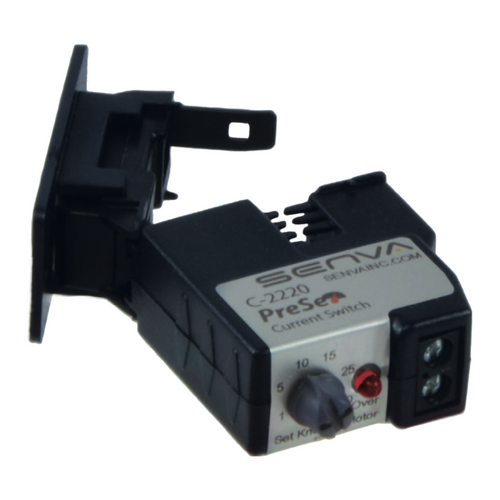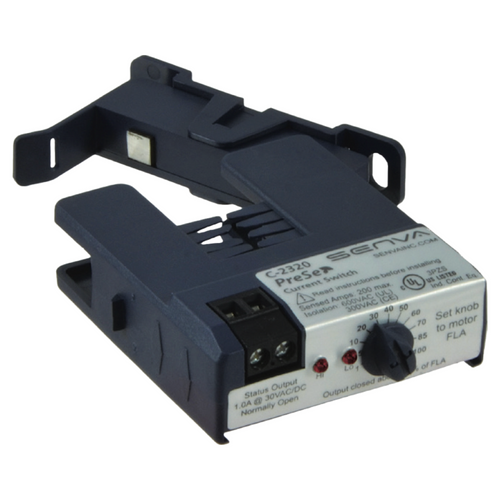


The Senva C-2220-L ECM is a mini split-core, normally open current switch built for EC motor status. Its ECTune sensing (patent pending) reads the full current waveform, giving a 0.03 A (30 mA) minimum turn-on point, a 0.03 to 0.50 A adjustable trip range across a 0 to 50 A span, and setpoint resolution as low as 5 mA.
EC motors draw measurable current while commanded off. Senva reports that in many cases the current a standard clamp-on sensor measures is almost indistinguishable between running and idle, and that is where false ON status and the service callbacks that follow come from. The ECMSet Pro is Senva's answer to that specific problem: a lower turn-on point, finer resolution, and a lettered tool-free dial so the setting is repeatable across identical equipment.
Specifications on this page are drawn from the Senva ECMSet Pro datasheet and Installation Instructions document #152-0041-0A, revised 12/23/2024.
Best For
- Go / no-go run status on EC motor driven fans and pumps
- Retrofits where standby current has been causing false ON status and callbacks
- Tight enclosures where a full-size split-core will not fit
- Repeat installations on identical motors, using a recorded dial letter
- Small non-ECM loads that fall below a conventional current switch's turn-on point
Warranty
Key Features
ECTune waveform sensing (patent pending)
A standard clamp-on CT estimates RMS current by assuming a clean sine wave. An EC motor at partial speed does not produce one. ECTune reads the entire waveform including distortion, so the difference between idle and running becomes far easier to resolve. In Senva's EBM Pabst test, a standard CT saw roughly 8 mA between idle and minimum speed; ECTune saw roughly 54 mA on the same motor.
30 mA turn-on reduces the need for wire wraps
The minimum turn-on point is 0.03 A. That is 8x lower than the 0.25 A minimum on the ECMSet Classic C-2320-L ECM, which minimizes the need to wrap the conductor through the sensor in tight enclosures or where there is not enough spare wire to work with. If a motor's minimum run current still cannot power the device at dial position A, the installation instructions call for a wrap.
5 mA resolution stops false status from standby current
EC motors draw current when they are commanded off. Resolution down to 5 mA lets you set the trip point above that standby draw instead of on top of it, which is what turns a nuisance alarm into a clean ON/OFF report at the controller.
Tool-free lettered dial, single turn
A 240 degree single-turn knob lettered A through K sets the trip point. No screwdriver, no multi-turn potentiometer counting. Senva notes the tool-free knob can be set with gloved fingers, which reduces the risk of slips or shorts when working near a live panel.
Repeat installs without live calibration
Because the dial is lettered rather than blank, the position that worked on the first unit can be dialed into every matching unit before it goes in the panel. Senva publishes starting positions for four common motors: EBM Papst R3G250-RE21-08, R3G220-R and W3G250-HK35-11, plus Delta AFL22AUHW-P1, all at setpoint A.
Mini split-core that actually fits
1.9 x 1.35 x 0.6 in. with a 0.375 in. aperture. The flexible iris hangs on the conductor where local codes permit, and the included bracket screw-mounts or clips to DIN rail, so the sensor can be added without pulling the conductor out of the way.
Technical Specifications
| Specification | C-2220-L ECM |
|---|---|
| Type | Split-Core Current Switch (mini split-core) |
| Technology | ECTune (patent pending) |
| Amperage Range | 0 A to 50 A |
| Trip Adjustment Range | 0.03 A to 0.50 A (varies by motor type) |
| Minimum Turn-On Point | 0.03 A (30 mA) |
| Setpoint Resolution | As low as 5 mA |
| Dial Adjustment | 240 degrees, no tools required, lettered A to K |
| Output Type | N.O., solid-state FET |
| Output Rating | 1.0 A @ 30 VAC/DC max. |
| Contact "On" Resistance | <10 ohms |
| Contact "Off" Resistance | >1 megohm |
| Response Time | <3 s |
| Hysteresis | 2 to 6% |
| Power/Status LED | Power (red), Contact closed (green) |
| Sensor Power | Induced |
| Frequency Range | 50/60 Hz |
| Sensor Aperture | 0.375 in. |
| Dimensions (L x W x H) | 1.9 in. x 1.35 in. x 0.6 in. (2.0 in. x 1.6 in. x 0.6 in. with bracket) |
| Operating Temperature | 5 to 140 °F (-15 to 60 °C) |
| Operating Humidity | 10 to 90% RH, non-condensing |
| Maximum Surrounding Air Ambient | 60 °C |
| Pollution Degree | 2 |
| Insulation Class | 600 V RMS. For use on insulated conductors only. Use minimum 75 °C insulated conductor. |
| Maximum Conductor Voltage | 600 VAC max. |
| Digital Input Wetting Voltage | Not to exceed 30 VAC/DC |
| Terminal Torque | 3.5 in-lb |
| Mounting | Flexible iris (hang on conductor where local codes permit); included bracket for screw mount or DIN rail |
| Polarity | Not polarity sensitive |
| Compliance | cUL, UL, CE, RoHS |
| Country of Origin | United States (Beaverton, OR) |
| Warranty | 7 years |
Documentation
 ECMSet Pro DatasheetFull specifications, ordering table and dimensions.
- Installation InstructionsDoc #152-0041-0A, rev. 12/23/2024. Wiring diagrams, calibration procedures and troubleshooting.
- Application Note: What is ECTune?Waveform test data behind the 30 mA turn-on claim.
- Application Note: How to Tune the Adjustable DialStep-by-step A to K calibration guide with pre-set motor table.
- ECMSet Classic vs. ECMSet Pro Upgrade GuideSide-by-side comparison against the C-2320-L ECM.
- Senva Commerce Declaration (BABAA / TAA / ARRA)Updated 04/21/2026. Covers the C-2200 and C-2220 series.
Related Products
Larger split-core with a 0.75 in. aperture, 0.25 to 200 A range and support for the optional CR3/CR4 command relay add-on.
Browse the full ZOT Supply current switch range by core type, contact type and amp range.
Frequently Asked Questions
What is the lowest current the C-2220-L ECM can detect?
The published minimum turn-on point is 0.03 A (30 mA), with setpoint resolution as low as 5 mA. The adjustable trip range runs from 0.03 A to 0.50 A, and the sensor reads up to 50 A. Use 30 mA as the rated figure when sizing an application. Senva separately reports a manufacturer bench observation, which is not a rated specification: in one logged test an EBM Pabst W3G250-HK35-11 fan drawing 27 mA idle and 49 mA at minimum speed was detected repeatably with no wraps, which is why Senva describes the 30 mA figure as conservative.
What is ECTune and why does it matter on EC motors?
ECTune is Senva's patent-pending sensing method, built into the ECMSet Pro. It does two things: it lets the CT harvest enough power to operate at very low currents, and it evaluates the full current waveform rather than assuming a perfect sine wave. Because an EC motor running at partial speed produces a heavily distorted waveform, reading the whole picture helps distinguish running from idle in applications where a conventional CT has difficulty separating those states.
Do I still need a wire wrap?
The 30 mA minimum turn-on reduces the need for a wire wrap. If the motor's minimum run current is still not enough to power the device with the dial at position A, the installation instructions call for a wire wrap. Each additional turn through the sensor increases the current the sensor sees by 1x, so do not exceed the 50 A maximum once wraps are counted.
How do I set the A to K dial?
Senva documents two methods. Pre-set calibration avoids working in a live enclosure: set the knob to A, test the motor at minimum speed and off, and step the dial up one letter at a time until the switch state matches the motor. Conventional calibration starts at K, runs the motor at minimum speed, turns the dial down until the LED goes green, then steps up one labeled position. Record the final letter for the next identical motor.
Does the setting change in cold weather?
Yes. For installations expected to see temperatures below 0 °C, Senva recommends adjusting the dial up (clockwise) one additional letter position.
How is this different from the C-2320-L ECM (ECMSet Classic)?
The Pro trips 8x lower (0.03 A vs. 0.25 A), adds 5 mA resolution, and is physically smaller (1.9 x 1.35 x 0.6 in. with a 0.375 in. aperture, against 2.94 x 2.23 x 0.82 in. with a 0.75 in. aperture). The trade-offs: the Classic covers 0.25 to 200 A where the Pro tops out at 50 A, and the Pro does not accept the optional CR3/CR4 command relay add-on.
How do I wire the output to my controller?
The output is a normally open solid-state FET rated 1.0 A @ 30 VAC/DC. Wire it to a control panel digital input loop not exceeding 30 VAC/DC wetting voltage and torque the terminals to 3.5 in-lb. The device is not polarity sensitive, and Senva publishes sinking, sourcing and AC controller arrangements in the installation instructions. Note that testing the solid-state output with an ohm meter can read about 1 ohm or less, which is normal.
Is the C-2220-L ECM Made in USA and BABAA compliant?
Yes. Senva's Commerce Declaration updated 04/21/2026 lists the C-2220 series among current sensing products manufactured in the United States at Beaverton, Oregon, with domestic component cost exceeding 65 percent, meeting Buy America (49 CFR 661.5(d)), the Buy American Act (41 U.S.C. 10a), ARRA Section 1605, BABAA and the Trade Agreements Act. Country of origin is stated as U.S.A.
7-Year Warranty. Senva warrants the C-2220-L ECM for 7 years. Contact ZOT Supply for a return authorization before shipping any product back for warranty evaluation.
- Type:
- Current Switch
- Mounting Type:
- Split-Core
- Product Series:
- ECMSet Pro
- Setpoint:
- Adjustable Trip
- Contact Type:
- Normally Open
- Amp Range:
- 0-50A
- Trip Range:
- 0.03-0.50A
- Contact Rating:
- 1.0A @ 30VAC/DC
- Sensor Aperture:
- 0.375 in
- Contact Termination:
- Terminal Strip
- Country of Origin:
- USA