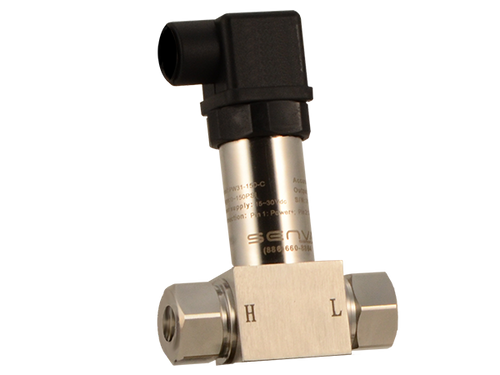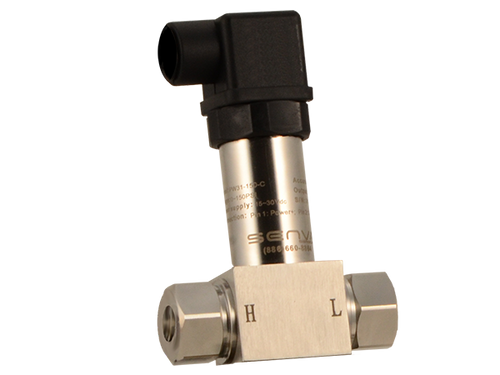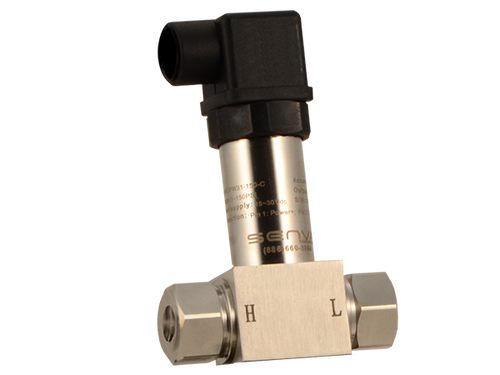

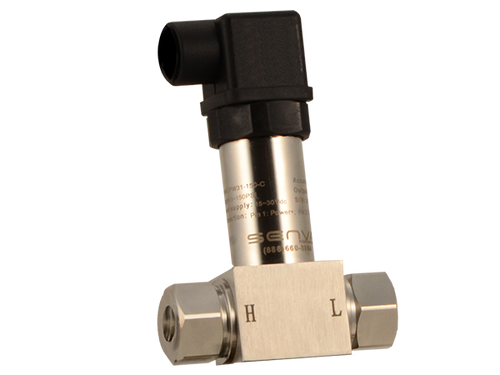
The Senva PW31-X-100C is a wet-to-wet differential pressure transducer engineered for accurate liquid DP measurement in hydronic HVAC and process systems, shipped as a standalone transducer (no manifold). Its single-diaphragm sensing element eliminates the line-pressure-effect drift common to dual-sensor differential systems and delivers ±0.25% full-scale accuracy across the entire 0–100 PSID range — making it suitable for higher-head pump applications, large hydronic plant DP control, process pressure differential monitoring, and any application where the working differential lives within the 0–100 PSID envelope.
Built with 316L stainless steel construction, Fluororubber (Viton) O-rings, and a laser-welded IP65 sensor enclosure, the PW31 is suitable for water, glycol mixtures, and 316L-compatible liquids and gases. The 2-wire 4–20 mA loop-powered output and DIN 43650A electrical connection make it a clean drop-in for BAS analog inputs, with screw terminals and an included 1/2" conduit adapter for simplified field wiring.
High-head hydronic plant pump DP, large boiler plant differential, condenser water loop pump head, primary loop DP control on large chiller plants, and process pressure differential applications in the 25–100 PSID envelope.
Key Features
A single temperature-compensated diaphragm measures the differential directly — eliminating the line-pressure-effect error inherent to remote dual-sensor configurations. Accuracy spec (±0.25 PSID at full scale on this 0–100 PSID range) includes non-linearity, hysteresis, repeatability, zero, and span tolerance.
Solid-state sensing element with no moving parts. Long-term stability of ±0.5% FS per year and zero-shift line pressure effect of ≤0.0035% FS per PSIG keep the sensor inside spec for the long haul without periodic recalibration.
Sensor body and diaphragm are 316L SS with Fluororubber (Viton) O-rings — compatible with water, water-glycol mixtures, and other liquids and gases compatible with 316L SS and Viton. Laser-welded IP65 sensor enclosure withstands washdown and harsh mechanical-room environments.
2-wire 4–20 mA current loop output. Loop powered — the sensor draws its operating power from the 4–20 mA loop itself, so only two wires are needed back to the controller. Noise-immune over long cable runs.
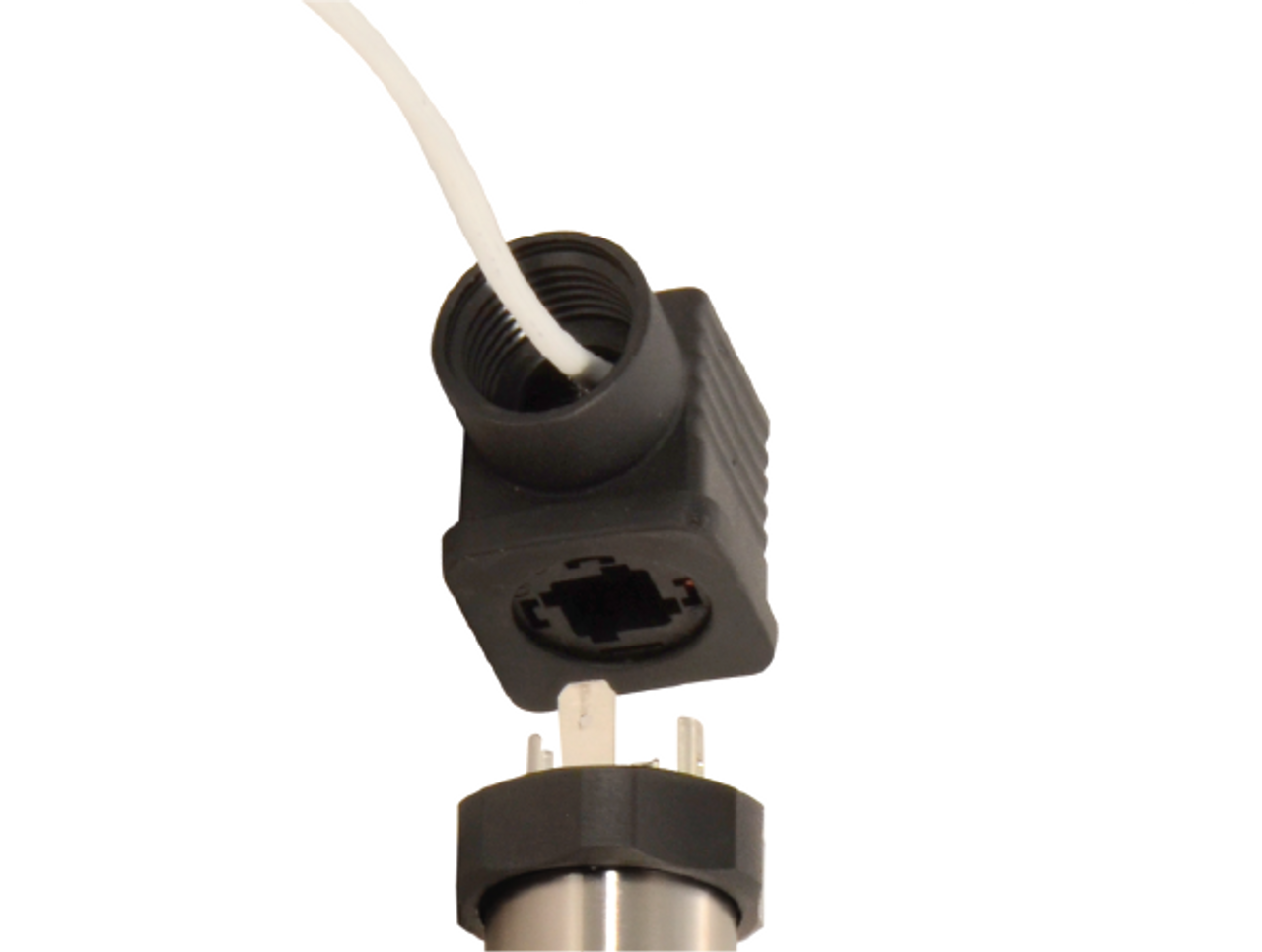
Standard DIN 43650 Form A electrical connector with screw terminals — no field splicing required. A 1/2" conduit adapter is included in the box for clean EMT, flex, or liquid-tight conduit runs.
Every PW31 ships from Senva with a calibration certificate documenting the unit's individual calibration data. No field calibration is necessary or recommended — the device is deployment-ready out of the box.
Technical Specifications
| Specification | Value |
|---|---|
| Series | PW31 |
| Manufacturer Part Number | PW31-X-100C |
| Sensor Type | Micro-machined silicon strain gauge, single diaphragm |
| Media Compatibility | 316L SS-compatible liquids and gases (water, water-glycol mixtures) |
| Differential Pressure Range | 0–100 PSID |
| Accuracy | ±0.25% FS (±0.25 PSID at full scale) |
| Long-Term Stability | ±0.5% FS / year |
| Differential Overload Pressure | 150 PSID (150% FS) |
| Maximum Static (Line) Pressure | 500 PSIG (500% FS) |
| Line Pressure Effect | Zero shift ≤0.0035% FS per PSIG |
| Temp Coefficient (Zero) | ±1.1% FS / 100°F |
| Temp Coefficient (Span) | ±1.1% FS / 100°F |
| Output Signal | 2-wire 4–20 mA active |
| Power Supply | 15–35 VDC, 20 mA max |
| Operating Temperature (Electronics) | −4 to 175°F (−20 to 80°C) |
| Compensated Temperature Range | 30 to 158°F (0 to 70°C) |
| Pressure Connection | 1/4" NPT Female |
| Electrical Connection | DIN 43650A |
| Bypass Manifold | None (standalone transducer) |
| Sensor Enclosure | Laser-welded 316 stainless steel, IP65 |
| Wetted Materials | 316L stainless steel, Fluororubber (Viton) O-rings |
| Shock / Vibration | 30G shock; 5G @ 50 Hz; 10G peak |
| EMI/RFI Protection | Per CE Requirements |
| Conduit Adapter | 1/2" included |
| Agency | CE, RoHS |
| Warranty | 7-year manufacturer warranty |
What’s In the Box
- PW31 wet-to-wet differential pressure transducer (0–100 PSID, 4–20 mA output)
- DIN 43650A connector with screw terminals
- 1/2" conduit adapter
- Calibration certificate
- Installation instructions (also available below as PDF)
Documentation
Frequently Asked Questions
The PW31-X-100C is a wet-to-wet differential pressure transducer that measures liquid pressure difference between two ports across the 0–100 PSID range and outputs a 2-wire 4–20 mA loop-powered current signal proportional to that differential. It delivers ±0.25% FS accuracy (±0.25 PSID at full scale) and is designed for direct connection to BAS analog inputs.
The 0–100 PSID range is the right choice when your working differential falls in the upper portion of that range — large high-head pump applications, big boiler plant differentials, district energy systems. For lower-DP applications (chiller evaporator, balance valves, small-loop pumps), the 0–5, 0–10, or 0–25 PSID variants give substantially better effective resolution. Match the sensor range to the working DP, not to the worst-case static line pressure (which is handled separately by the 500% FS maximum static rating).
500 PSIG maximum static pressure on both ports to maintain rated accuracy. The line pressure effect is ≤0.0035% FS per PSIG of static pressure (zero shift), so at the full 500 PSIG static line condition you would see a maximum zero offset of about 1.7500 PSID — well inside normal calibration drift. If your system runs at higher static pressures, you need a higher-range PW31 (max static scales with DP range at 5×).
Yes. The wetted parts are 316L stainless steel with Fluororubber (Viton) O-rings — compatible with water, water-glycol mixtures (propylene and ethylene), and any liquid or gas compatible with both 316L SS and Viton. For unusual chemistries, verify compatibility against both materials before specifying.
No. Every PW31 ships from Senva factory-calibrated with a calibration certificate documenting the unit-specific calibration data. Field calibration is neither necessary nor recommended — if a sensor reads incorrectly, the most common cause is trapped air in the pressure lines (see the bleed procedure in the installation instructions), not sensor drift.
A single-diaphragm differential sensor measures the pressure difference directly — the line pressure cancels out at the diaphragm. A pair of single-port gauge-pressure sensors computing the difference electronically inherits the full-scale error of both sensors AND is affected by line-pressure-effect drift on each side. For low-DP applications at moderate-to-high line pressures, the single-diaphragm approach delivers an order of magnitude better effective accuracy.
It means the sensor's zero and span calibration may drift by up to ±0.5% of full scale (±0.5 PSID on this 0–100 range) per year of continuous service under normal conditions. In practice, with stable wetted media and within compensated temperature range, most PW31 sensors show drift well inside this spec. For most BAS applications the drift over a 5–7 year service life remains within the original accuracy envelope.
The -X- suffix means “no bypass manifold” — the transducer ships as a standalone unit. A bypass manifold (3-valve or 5-valve) lets you isolate and equalize the sensor without depressurizing the system, which is required by many institutional specs for service and commissioning. If your spec calls for a manifold, order the PW31-3V-100C (3-valve) or PW31-5V-100C (5-valve) variant instead.
Yes. The PW31 LED display is loop-powered and connects in series with the 4–20 mA output via a Hirschmann-style connector. You can order the display separately as a retrofit, or order the PW31-X-100C-D variant up front with the display pre-fitted. The display only works with 4–20 mA loop-powered output — not available for the 0–5V or 0–10V variants.
- Series:
- PW31
- Pressure Type:
- Differential
- Media:
- Wet
- Bypass:
- None
- Pressure Range:
- 0-100 PSID
- Output Signal:
- 4-20mA
- Display:
- No